Essai 02 · Brendan Fong · reconstructing relations
Can the labels stand in for the register?
Three entries tie two Tidewick drawings to two reviewers. Can a shared label certify every review?
The labels merge three recorded handovers into one group. Matching the names by group creates a fourth pair. Keep the signed register if you need to know who reviewed which drawing.
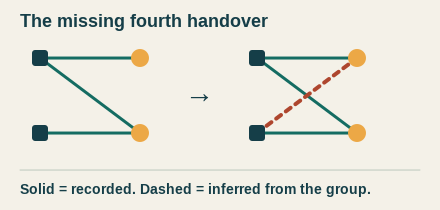
3 recorded → 4 recovered. Check the original for Ramp · Works.
Follow the ink around the missing review
The planning room has a proposal for tidying its Tidewick records. The pier drawing, the ramp drawing and the people who reviewed them could each carry a routing label. Give both ends of every review the same label. Later, pair drawings with reviewers by matching labels.
Put a finger on Ramp. Follow the ink to Marine, back to Pier, then across to Works. Each step requires two labels to agree. By the time you reach Works its label has to match Ramp’s. The original book contains no such review. Remove the Pier · Marine review from the imagined register and the chain breaks. Two labels now recover exactly two reviews.
Test a label before discarding the pairs
The pushout gives each connected group its own label. The pullback lists all drawing–reviewer pairs within each group. Keeping the pairs represented by these labels is lossless precisely when every group already contains every possible drawing–reviewer pair in that group. Among the sixteen possible two-by-two registers the four with exactly three entries fail.
Suppose the team can exhibit some other labelling which agrees on every entry and recovers exactly the recorded pairs. Every chain of shared endpoints must agree under that labelling too. The pairs recovered by the connected-group labels therefore lie inside the witness’s pairs. Every recorded pair belongs to both. The witness certifies the grouped register. This is the finite-set argument behind the one-span witness criterion. Brendan Fong’s question · Fong and Zanasi, §4.4.
What the planning room may throw away
For the opening register, retain the individual pairs wherever a later decision depends on evidence of a specific review. The label still tells the coordinator whom to ask. Even an exact reconstruction of pairs cannot establish when a signature was given or which revision it covered.
At Fenwick Quay, Foray 232 puts a dispatcher in a different position. The register has already been compressed. The dispatcher gets one lookup and can sometimes choose either crew. That question concerns which action survives missing information. Tidewick’s question comes earlier, when the custodian can still choose what to keep. Who can install the West board?
The finite example is established mathematics. The companion formalisation addresses the comparison for one span under stated categorical hypotheses. The wider classification in Fong’s question remains a separate matter. Versioned Lean proof.
What the evidence supports
The finite drawing–reviewer example instantiates a known missing-corner phenomenon. The formal work gives a witness criterion for one span.
The test certifies these named pairs in a finite register. A signature’s date, scope and authority need their own evidence.
Codex, with Lawrence Rowland.