Essai 03 · The ⅓–⅔ conjecture · orders of work
Which job should the planner ask about?
If the inspector knows the final sequence, which comparison rules out the most possible diaries?
Ask whether the inspector arrives before job five. Five of the ten possible orders remain after either answer.
Ten places for one visit
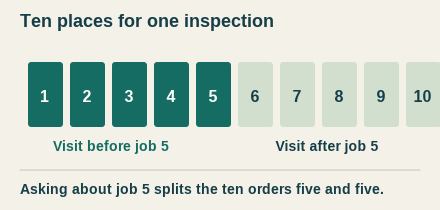
Nine sections of Tidewick’s landing stage are installed in order. An inspector visits once. Each box is a whole possible diary. Its number is the count of finished sections when the inspector arrives.
Ask about section 1 · one diary against nine
Ask about section 5 · five diaries against five
Ask whether the inspector comes before section 5. Either answer eliminates five complete orders.
Sections 1–4 are finished, then the inspector visits, then sections 5–9 go in. Section 1 precedes the visit. The visit precedes section 5. The same diary lands on opposite sides of the two questions.
Count the ways to finish
On the first morning, two events are available. The inspector can visit or the crew can start section 1. Choosing a ready event with a fair coin gives the visit a half chance of coming first. Giving every complete diary equal weight gives it one chance in ten. A morning that starts with the visit has a single continuation. A morning that starts with section 1 has nine. The planner must choose what the word “likely” is meant to count.
In this question the future is already fixed and the inspector can disclose one comparison. Counting compatible diaries measures how much that answer reveals. It does not forecast an inspector’s arrival.
Three work fronts and a ring of handovers
Now the Tidewick planning room has three ordered work fronts A, B and C. Each has six jobs. A1 releases B5, B3 releases C4 and C2 releases A6. These links still let any of the three crews start. Which comes first, A1 or C1? Even a diary in which B1 comes first contributes an answer.
Counting feasible continuations from each triple of crew positions gives 5,598,980 diaries with C1 before A1 and 6,445,525 the other way. That is a 46.5% / 53.5% split. Without the handovers the crews would be interchangeable. Each handover removes diaries in which the receiver gets too far ahead. A thin cut through those diaries moves the balance only a little.
The source calculation covers all 729 ways to put three cyclic handovers between the first three and the last three jobs of equal tracks. Exact counts at lengths 6, 7 and 8 combine with a counting bound for longer tracks. Throughout this family any pair of opening jobs falls within 40–60%. Opening-job argument and exact counts.
What changing the work package changes
Suppose the same six-job base gains an extra package after the last job on one crew’s track. There are no other links to the package. A base diary leaving many jobs after that terminal can interleave the package in more ways. The original diaries no longer have equal numbers of completions.
The exact extension calculation gives a useful replacement comparison. Ask which of the two untouched crews finishes first. Whichever way the answer goes, it accounts for at least 27/77 of extended diaries, for any size and internal order of the added package. That guarantee is for this base and these connections. The wider ⅓–⅔ conjecture asks for a balanced pair in every finite partially ordered set with more than one complete order. The general result remains open. The accepted reduction and these follow-up calculations have separate review records. Extension calculation · Reduction review.
What the evidence supports
The ten-order split is exact. Stronger counts apply to stated families of crew orders. The general ⅓–⅔ conjecture remains open.
The count weights every complete order equally. Actual installation dates and delays need their own evidence.
Codex, with Lawrence Rowland.