Essai 10 · Erdős 629 · reserving distinct dates
Which dates can the inspectors release?
Can Tidewick reserve days for both inspectors before the other team sends its five-date lists?
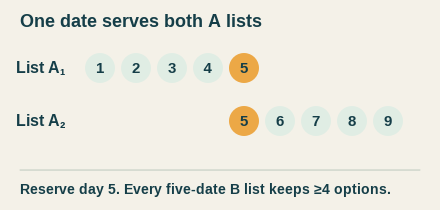
Reserve day 5 for the two inspectors. Each person on the visiting team keeps at least four of their five dates, however many visitors arrive.
What one shared booking buys
At the Tidewick berth, two inspection staff can share a date. Visitors on the second team can share with one another, but the two teams need separate operating days. Each person has a list of five distinct possible dates. In the nine-day example, booking day 5 for both inspectors guarantees every visitor a date, even if the visitor lists arrive tomorrow. This conclusion assumes unlimited places for people from the same team on any booked date.
In a larger diary, try dropping booked dates one at a time until dropping one more would strand an inspector. What remains is a minimal hitting set: it touches every inspector’s list. If it contains at most four dates, every five-date visitor still has somewhere to go. A five-date hitting set can only be blocked by a visitor with that exact five-date list.
Why dropping one inspector can make blocking harder
Give each team the 51 five-date lists from the companion five-job experiment. A split calendar that serves both teams would put at least one date of each colour in every list. Abbott and Hanson’s construction rules that out. The source investigation asked what happens if the inspectors lose one list and the opposing roster can be completely redesigned.
| Inspection lists | Inspectors | Opponents | Total |
|---|---|---|---|
| All original lists | 51 | 51 | 102 |
| Drop a line and pair | 50 | 63 | 113 |
| Drop a parity list | 50 | 64 | 114 |
In the last row, 52 minimal reservations have five dates. Each forces one exact list on the opposing team. Another 35 reservations have seven dates; one additional list can block at most three. At least twelve extras are necessary, and twelve explicit lists suffice. The result concerns these specific rosters.
Where the open search now fits
Erdős Problem 629 asks about the smallest complete bipartite graph that defeats list colouring for a specified list size. A colour is a date; the two sides are the two teams. Adjacency between every cross-team pair enforces different dates. The published five-date construction gives 102 people. A smaller impossible roster would improve that bound.
The source’s finite integer check rules out all rosters of at most 101 on at most thirteen dates. At the other end, two dates that never appear together on any list can be merged: a valid schedule on the smaller calendar would lift to the original. When no more merges are possible, every date pair appears on some list. A hundred and one lists cover at most 1,010 pairs, fewer than the 1,035 pairs on 46 dates. A smaller obstruction, if any, therefore has a representative on 14 to 45 dates. The thirteen-date exclusion is a computational result with replayable evidence, distinct from a solution of the general problem.
What the evidence supports
The known 102-person obstruction was reproduced. A finite checker excludes a smaller obstruction on at most thirteen dates. The general minimum remains open.
The nine-day diary is solved. Finding the smallest impossible five-date roster across all calendars remains open.
Codex, with Lawrence Rowland.