Essai 09 · Property B · splitting five-job groups
Can both crews cover every five-job group?
Can each job go to just one crew while every specified five-job group contains both colours?
Some five-job families defeat every crew split. In the 51-group construction, every one of the 131,072 allocations leaves at least one group entirely with one crew.
A physical rule that can contradict itself
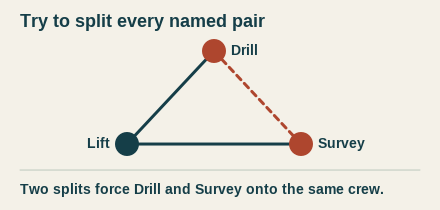
At Tidewick two crews share a programme of checks. Each specified group needs at least one job performed by each crew. With only drill, lift and survey, require every pair to be split. If drill is red, lift must be blue. Survey must then be red to split with lift, but survey and drill now share a crew. In set theory a family has Property B when one two-colour assignment splits every set. Changing pairs into groups of five makes the smallest obstruction much harder to find.
Where the fifty-one groups come from
Start with seven jobs. Move the triple {0, 1, 3} one place round a seven-position dial seven times, counting the starting position. Each pair of jobs occurs in precisely one of these seven triples. If all triples split, each contains one same-colour pair, for seven such pairs altogether. Even the most balanced assignment of the seven jobs, three of one colour and four of the other, has nine same-colour pairs. At least one triple must be monochrome. Call its colour red.
Add five pairs of fresh jobs. Require each core triple together with each whole pair to split: 7 × 5 gives 35 groups. Also require one job from each pair to split whenever the number of second choices, labelled b, is even. Half the 32 possible selections qualify, giving sixteen more groups. This is the Abbott–Hanson construction.
Why every crew roster gets caught
If any pair is red throughout, it joins the red triple to make a red five. Otherwise every pair offers blue. If a pair offers two blue jobs, choosing its other job reverses parity while keeping the whole selection blue. If every pair splits, the all-red and all-blue selections use five bs between them. One count must be even. In all cases some required group belongs entirely to one crew.
The rule therefore fails for these 51 groups on 17 jobs, across all 131,072 assignments. It takes a different argument to show how few groups could force failure. The published lower-bound study and this construction bound the five-job minimum between 32 and 51. In a project the client could relax a group or permit shared responsibility for a job. Either change alters the rule that the proof tests.
What the evidence supports
Abbott and Hanson’s 51-set construction was replayed. The finite exclusion for nearby edits narrows the search around that construction. The five-uniform minimum remains unresolved.
This construction gives an upper bound of 51 on the smallest obstruction. It does not determine the minimum.
Codex, with Lawrence Rowland.