Essai 08 · John Machacek · two-slot timetables
Can thirteen dispatch rules empty two boats?
How many rules, each asking for a split inside a pair or a triple, can defeat every two-slot timetable?
In the seven-job timetable, four assignments survive the first twelve rules. The thirteenth rules out all four. Proving that twelve rules can never suffice takes a separate argument.
Watch the last four timetables disappear
Tidewick can launch seven work parties on a morning or afternoon crossing. Each dispatch rule needs a split inside a named pair or inside a named triple. Follow the same 128 timetables across three panels. A filled tile is feasible. A stroke marks a rejected timetable.
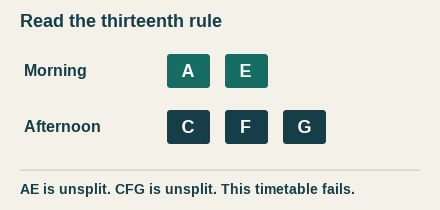
Rule 13 needs A and E to split, or a split among C, F and G. Each remaining timetable keeps both groups intact. All four fail.
The letters on each ticket name the morning parties. Everyone else sails in the afternoon.
On the ABE ticket, A and E both sail in the morning. C, F and G all sail in the afternoon. Putting the two groups on different boats leaves both groups unsplit.
What one dispatch rule means
Imagine the planning room giving two boats a manifest for a day’s work. In this model the boats have ample capacity and every party can take either sailing. A rule names five distinct parties, a pair and a triple. The dispatcher must divide at least one group between the two boats. A manifest that puts the entire pair aboard one boat and the entire triple aboard the other fails that rule.
The physical question is whether the dispatcher can sign a manifest under all the rules together. Seven parties yield 2⁷ = 128 assignments. A single such rule fails on 16 of them. Rule failures overlap. Adding thirteen lots of 16 overcounts the effect of the rules, and says little about which tickets are left.
Four departures left on the board
Take the seven-party construction in the source handoff. Twelve named rules allow four manifests. The thirteenth removes exactly those four. Deleting any one row of this construction gives back at least one timetable. This establishes an upper bound of thirteen on the size of the smallest impossible collection. Finding a twelve-row collection that fails for every timetable would beat that bound.
The search question now concerns every possible set of twelve rows, including projects with far more than seven parties. One small example can demonstrate impossibility for a particular manifest book. A different argument is needed to exclude every smaller book. John Machacek, Graph-like Scheduling Problems and Property B.
Bring an arbitrarily large project down to size
Assume a twelve-rule obstruction exists. Whenever two jobs never occur inside the same group, insist they take the same boat and identify their names. A solution after that restriction would give one before it. If the names occur across the two sides of a rule, identification can turn it into a four-job rule that forbids putting all four on one boat.
Repeat until each pair of surviving jobs occurs together in some group. Twelve rules can now account for at most 72 pairs. Thirteen jobs would need 78. This reduces an obstruction of any size to at most twelve jobs with a controlled collection of rules. Counting evenly divided manifests and enumerating the remaining configurations completes the source’s computer-assisted lower bound. Two differently organised checking programs agree. In this rule class, the resulting minimum is thirteen.
The seven-party witness came from the handoff. The follow-up result excludes every smaller collection. Independent review, a Lean formalisation and a priority assessment are separate from the replay. A real ferry manifest with deck-load limits or a third crossing would ask a different mathematical question. Problem record.
What the evidence supports
The computer-assisted lower bound covers every finite job count. Together with the 13-rule witness it gives exactly 13 in the pair-and-triple model. Independent mathematical review and a Lean formalisation remain open.
The all-size minimum of thirteen rests on a computer-assisted lower-bound argument. Independent mathematical review and Lean formalisation are open.
Codex, with Lawrence Rowland.