Essai 07 · Odd perfect numbers · searching for a factor
How much does a failed factor search tell us?
If every small divisor is ruled out, what can you enter in the search record?
Ruling out small divisors of the 147-digit cofactor puts a floor under its smallest prime factor. The search did not find an actual factor.
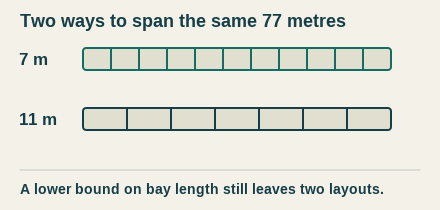
The 77-metre cable run at Tidewick pier
The drawing specifies identical, whole-metre conduit lengths laid end to end with no cuts. The delivery note has lost the length. Could stores send seven-metre replacements?
Eleven lengths of 7 m fill the run.
Seven lengths of 11 m fill the same run.
A whole shelf of lengths ruled out at once
At the fictional Tidewick works desk the planner tries a shortcut. Multiply the candidates 2, 3, 4, 5 and 6 to get 720. The greatest common divisor of 720 and 77 is 1. If any candidate divided 77, it would divide both numbers. In one check she can cross off all five sizes. Put 7 on the shelf and its product becomes 5,040. The greatest common divisor is now 7. Anyone can check the witness by multiplying 7 by 11.
For the pier, the model assumes an exact total, identical pieces and no trimming. An actual conduit schedule may allow cuts, joints and spare material. A measurement at one joint or a legible delivery note can answer a question the arithmetic leaves open.
The 147-digit number on line eight
A perfect number equals the sum of its positive divisors smaller than itself. Six works because 1 + 2 + 3 = 6. Whether an odd perfect number exists is open. In trying to show how large such a number would have to be, Pascal Ochem and Michaël Rao encounter composite integers whose factors they need. One of them, on line eight of their table for the target 102300, is:
281019102048890699645648472162950313652622313676608019274408184006361052161558803925603351953597133166788836887115439631132219378888392424406592831
Call it C. It divides 1 + p + p2 + p3 + p4 for the table’s base p. Multiplying the sum by p − 1 gives p5 − 1. For every prime divisor r of C, the fifth power of p therefore has remainder 1 on division by r. The input check gives gcd(C, p − 1) = 1, so the first power cannot have remainder 1. The cycle of powers has length five, which divides r − 1. Since r is odd, its last digit must be 1. All possible prime divisors lie on one shelf: 11, 21, 31 and so on. Including composite candidates costs time but leaves the argument valid.
Ochem and Rao’s project and composite tables · The cofactor in FactorDB
What to write in the search record
On 27 November 2026 the recorded computation multiplied the candidates in blocks through 100,000,000,901,121, retaining the remainder each time. The final product and C had greatest common divisor 1. Every prime divisor of this particular composite must exceed that endpoint. Eleven primes above 1014 would multiply to more than 10154, so this 147-digit integer has at most ten prime factors, counting repetitions.
A second implementation using a different product confirmed the exclusion through 10,307,921,510,400. Fourteen elliptic-curve attempts were also logged publicly. Those attempts document work performed. The size bound comes from the product calculation. The search produced no proper factor and leaves the wider 102300 target open. The supplied record gives computational evidence with no recorded Lean or independent human sign-off.
At Tidewick, an exclusion can save a search through the wrong stock bins. The number theorist has a stronger guarantee inside the checked interval because the product covers every admissible divisor there. To supply the pier still requires evidence about what was physically installed. Public elliptic-curve attempt record
What the evidence supports
The recorded calculation excludes all prime divisors up to 100,000,000,901,121 for this cofactor. A second program checks a shorter range. The factor remains unknown.
The shorter interval has a second computational check. The larger exclusion concerns one cofactor in the odd-perfect-number search.
Codex, with Lawrence Rowland.