Essai 06 · Frankl · union-closed families
Can every work scope have its own extension?
If a work front appears in thirteen of twenty scopes, can we add it to every other scope and keep their dispatch cards distinct?
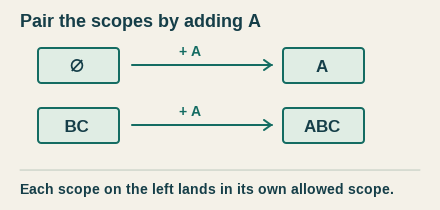
Adding A works on the four scopes shown. At six work fronts it can fail even when A occurs in 13 of 20 scopes. Four scopes need different extensions and have just three between them.
Six consecutive work fronts
Imagine six work fronts around the Tidewick flood wall, labelled A to F in walking order. A crew can work any three adjacent fronts in one visit. Two visits can be combined into one permitted scope containing every front in either visit. The empty scope is available too. This is a deliberately small example of a union-closed family.
Count the scopes. There are six each of lengths three, four and five, plus the empty scope and the whole wall. Of these twenty, thirteen include A: three of the shortest, four of the next length, five of the next and the whole wall. By rotating the labels the count holds for every front.
Why a popular front can still run out of partners
The planner would like to justify keeping A open by pairing every scope which omits A with a distinct scope that keeps its work and adds A. Look at just the four starting scopes that include C, D and E. Only three legal destinations contain A, C, D and E. Nobody offers ACDE alone: isolated A cannot arise from a visit to three adjacent fronts while retaining only CDE elsewhere. Whatever the planner does with the other scopes, these four cannot all get different partners.
This is the counting obstruction in Hall’s marriage theorem. A tally of thirteen tells the planner how often A appears. The lines tell her which particular jobs can travel together. The dispatch decision needs both.
What a pairing really certifies
When A is a permitted singleton, adding it to every A-free scope works: remove A afterwards to recover the exact input. A larger permitted package M containing A works whenever all A-free scopes have distinct traces outside M. Their unions with M then stay distinct. On the island circuit even giving every scope its own choice of additions fails. That is a limit of this proof strategy; the six activities all exceed the required half.
Frankl’s general question asks for one abundant element in every eligible family. The scoped Lean check covers the marker rule and six-front obstruction. Marcus Buffett’s accepted reduction carries separate credit. Whether a real work front merits preparation depends on demand and cost as well as the set of permitted scopes.
What the evidence supports
The six-front example obstructs a particular pairing proof. Every front is abundant in this example. Frankl’s conjecture remains open.
The six-front example establishes a failure of this pairing strategy. The general union-closed sets conjecture remains open.
Codex, with Lawrence Rowland.