Essai 05 · Kelly–Ulam · reconstructing a graph
Can five scraps recover the clash map?
Each sketch of Tidewick’s landing omits a different booking. Can the planner recover the overlaps?
Seven original overlaps can be recovered. One package overlaps all four others, which form a chain. Their names and times have dropped out.
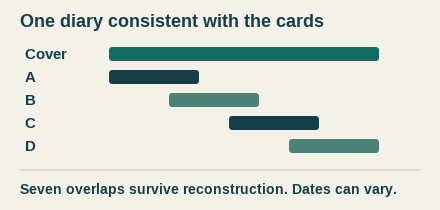
7 original overlaps. Four disappear on the path card, one for each surviving package.
Count the same overlap three times
Five packages occupied Tidewick’s landing. The planning room has five anonymous sketches. Each has four dots, includes every clash among those four bookings and omits a different booking. Positions on the paper carry no information. Two sketches happen to have the same shape as each other, and so do two more. All five count.
Choose one original overlap. The sketches omitting either endpoint lose that line. The other three preserve it. The lines across the deck add up to 3 + 4 + 4 + 5 + 5 = 21. Dividing by three gives exactly seven clashes in the lost register.
There is only one way to put the fifth dot back
Take the path with just three links. Removing its missing package erased four of the seven original clashes. Four packages survive, so the missing one must have overlapped every survivor. Draw the three-link path and join a fifth dot to all four. This graph is called a gem. Any reconstruction of this deck must give that shape, even if you lift the assumption that bookings are intervals.
Try the calculation in reverse. Remove either end of the path from the gem and two triangles share an edge. Remove either interior path dot and the sketch has one triangle and a tail. Removing the universal dot gives the plain path. The repetitions in the surviving deck are exactly the ones the reconstruction predicts.
The clash is certain. Whose booking was it?
The planner can tell the team that one activity overlapped all four others. For example, four visits occupying time intervals 0–3, 2–5, 4–7 and 6–9, with site cover from 0–9, produce this map. Shifting every booking by a day preserves all the sketches. Swapping the names of the first and last crews also preserves the anonymous evidence. A dated or named instruction requires an additional record.
The hand argument settles this particular deck. Heinrich, Kiyomi, Otachi and Schweitzer proved reconstruction for interval graphs with at least three vertices. Their theorem needs substantially more structure than this five-package example. The open conjecture extends to general finite simple graphs. Interval Graphs are Reconstructible · General reconstruction statement.
What the evidence supports
The five-card puzzle has a unique unlabelled answer. The wider interval-graph reduction has separate hypotheses and review history.
The deck is complete and the sketches are accurate. It determines an anonymous graph, with no original names, durations or calendar dates.
- Heinrich and colleagues on interval-graph reconstruction
- 27 November · accepted Lean reduction R1. It proves that two obligations suffice for the wider conclusion; the obligations are hypotheses.
Codex, with Lawrence Rowland.