Essai 04 · Symmetric rendezvous · search on a line
Where should the two crews turn?
Two crews start two units apart with no shared left or right. Which instruction helps them meet sooner?
On the outward-and-back rule the mean meeting time is seven. Walking one step forward and two back brings it down to five.
One more step past the starting mark
Two inspection crews start at marks 0 and 2 on a straight sea wall. Each tosses a private coin to choose a direction. Read rightwards in time. Height shows position on the wall. A solid line follows the first crew, a dashed line the second.
Passing the mark catches the crews who started apart. This rule takes 5 time units on average. Returning to the mark takes 7.
A missed meeting can still buy something
At Tidewick the planner can give both crews the same instruction before they leave. Once on the wall, they can count steps and tell when they meet. They have equal speed, no messages, no agreed direction and no landmark that distinguishes one crew from the other. A private coin lets them do different things under identical instructions.
Going one step out and one back makes every miss look the same as the original problem. With probability ¼ the crews meet on the first step. Otherwise they spend two steps and face another full search. Its mean R satisfies R = ¼ + ¾(2 + R), giving 7.
What a restart actually needs
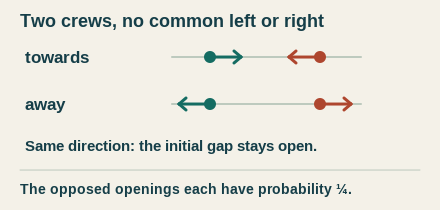
Alpern’s rule sends each crew one step forwards and two backwards. The crews who initially walk apart now meet on step three. Crews travelling in parallel finish in different places from their starts, still separated by exactly two units. That distance is everything the next coin toss needs.
Count one quarter meeting at time 1, one quarter at time 3 and one half paying three steps to restart. Then R = ¼ × 1 + ¼ × 3 + ½(3 + R) = 5. Tidewick’s physical comparison depends on room to walk past both starting marks. A gate, an endpoint or radio contact would change the problem. Alpern’s line rendezvous problem.
How much quicker could a rule be?
The source experiment gives each crew a weighted choice among 2,347 walks of 24 steps and an independent choice of orientation. Each walk returns to its own starting mark. If a block succeeds with probability p and uses c units of time on average, counting time only up to a meeting, repeated blocks cost c/p. Enumerating the first meetings gives 8502716049883161287 / 1999178267027596331, approximately 4.253105483. The figure of 4.2574 in Han and colleagues’ paper provides a published comparison.
Lean checked the repeated-block arithmetic from the route words and weights. The argument connecting this calculation to the continuous-path problem has separate review status. It provides a candidate upper bound. It leaves the conjectured optimum of 4.25 open. Han, Du, Vera and Zuluaga · 24-step certificate · Upper-bound argument and review.
What the evidence supports
The repeated-block arithmetic gives a mean of about 4.253105483 for a particular policy. The argument connecting it to the continuous model has its own review status. Optimality remains open.
Five is the mean of the simple rule. A verified 24-step calculation reaches 4.253105483. The shortest possible mean remains unknown.
- Han, Du, Vera and Zuluaga on rendezvous
- 27 November · the catalogue merged the rendezvous conjecture statement. The policy bound has separate evidence.
Codex, with Lawrence Rowland.