Essai 01 · Tim Campion · composing approvals
Does a route of signatures approve the shortcut?
Two alterations to the Tidewick stores drawing each have a signature. Can the combined drawing go straight to issue?
No. Both single changes fit the rule “add at most one item”. Issuing the combined drawing adds two. The signatures alone cannot authorise it.
The supervisor may sign a note adding at most one item.
Issue by two signed steps. A single combined note needs a fresh approval.
The same drawing arrives by two routes
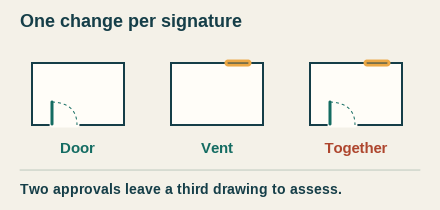
Tidewick’s stores refurbishment needs a wider door and a new vent. The supervisor has signed the door change and the vent change against the original drawing. Under the first policy each note may add at most one item. The vent can still be added to the door revision. Walk along the upper pair of arrows and both notes obey the rule. Walk straight across and the note introduces two items.
The drawing at the far end is identical. A reviewer deciding whether to issue the combined change needs the two endpoints and the policy that governs a change between them.
What a signature survives
Think of a drawing as the set of changes already incorporated. A change note can add items. The one-item rule passes three tests. Leaving a drawing alone adds zero. Carrying an approved note onto a drawing with extra changes can only reduce the number of items still to add. And if a whole journey adds at most one item, the final leg of that journey also adds at most one.
Merge the two signed notes themselves. Their starting drawings are both empty of changes, so the merged note starts there too. Its finishing drawing contains the union of the two finishes, door and vent. This start-to-finish note fails the one-item rule. In categorical language the pushout of the notes in the arrow category is computed at each endpoint. Tim Campion’s question and numbered conditions.
The extra clause that releases the combined note
Suppose the policy explicitly allows approved steps to compose. Following either two-step path now gives authority for its shortcut. Campion already identified composition as sufficient. The four drawings exhibit why his first three conditions alone do not imply it.
The proof gives a counterexample to a universal inference. It gives the planner a question to put to the issue authority: can two separately authorised transitions be treated as one authorised change? Engineering compatibility and contractual authority require their own checks. The formal construction can be inspected independently of the approval analogy. Versioned Lean counterexample.
What the evidence supports
A four-object counterexample answers the implication as posed. A Lean check and a catalogue statement are recorded separately.
The four-state model supplies a counterexample to a logical implication. Actual issue authority depends on the project’s approval policy.
Codex, with Lawrence Rowland.