01 · Keep the interfaces honest
Open a wall module. Follow both workers, the materials and returned access. A replacement must keep more than the shape of its ports.
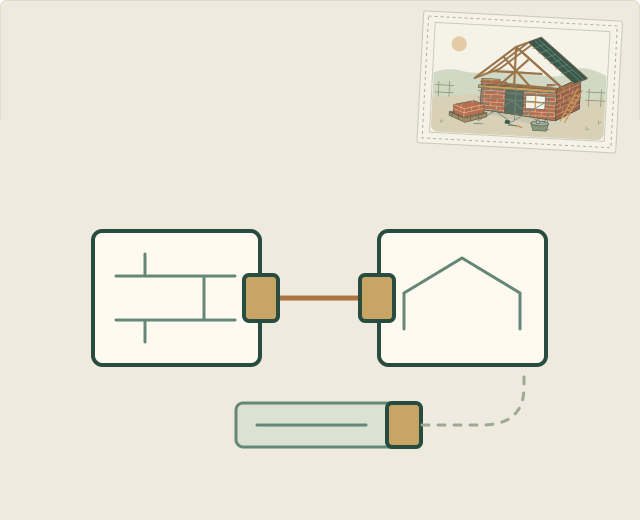
Foray 160 · Building a Wall
What must one piece of work provide before another can begin? Make those interfaces explicit, then explore how small project blocks can fit together and be reused.
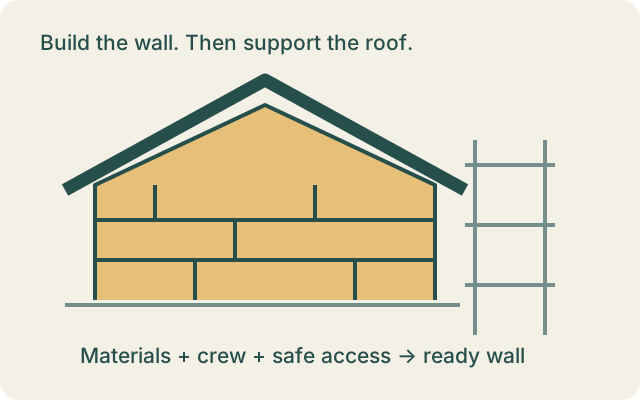
Toy scenario
Brickwork needs materials, labour and access. Roof work needs a wall with the right readiness and support. The examples make these package interfaces explicit so that connecting two diagrams also means connecting compatible conditions and promises.
When do individually acceptable work packages make an acceptable whole?
Start here · Interactive essay
Follow a small construction example from materials and preparation to a wall and roof. Inspect what each process needs and produces, change its readiness conditions, and see what those choices mean downstream.
Open the essaySeparate a correctly connected diagram from work whose stated preconditions are satisfied.
Explore a module through its inputs and outputs, and open it to inspect the work inside.
Read computed checks against the model’s explicit rules and see the limits of what they establish.
Three essays · one enquiry
Open a wall module. Follow both workers, the materials and returned access. A replacement must keep more than the shape of its ports.
See what an operad algebra actually supplies. Compute relations, inspect typed composition laws and eliminate hidden wall–roof variables.
Carry materials and a growing wall through repeated work. Discover why emitting two courses is not yet building one wall.
The wider enquiry
The construction example is a starting point. The larger question is whether a project can be assembled from understandable blocks, each with a clear boundary and an account of how it behaves.
Make project dependencies, hand-offs and readiness conditions visible enough to question, explain and reuse.
Connect typed inputs and outputs, attach explicit conditions, and compare a module with the work it contains.
Small interactive models, wiring diagrams, port tables and computed checks, supported by the language of composition.
Earlier explorations
The catalogue keeps all eleven experiments reachable. Three maintained essays now connect the resource model, its algebra and repeated work. The eight earlier experiments retain their distinct workings; their limits are described at the relevant entrances.
These are exploratory teaching models. Their checks concern the rules represented in each model; they do not establish engineering safety, a complete schedule or suitability for a real project. Selected older operad, contract and serial-wiring experiments have received scope corrections; other earlier experiments retain their original exploratory status.