
Exploring arrows, functors and transformations

Functors for Projects

How can different views of a project fit together? Try a delivery conversation, then a change that reaches across regional plans.

Functors for Projects · The Island Reading Room
Books wait on a boat below an island reading room. Two coordinators consider the jetty and shore path.
The Island Reading Room · a fictional delivery problem

Compose a conversation

The books are here.
Can the plans agree?

The jetty is unavailable, but the shore path is open. One coordinator offers access; the other decides whether the books can travel that way.

Step through the exchanges: one coordinator’s answer becomes the other’s next input.

Open the Island Reading Room →
First comparison to try
  1. Keep the opening choices. Use Next exchange twice, then Supply landing report and Show remaining exchanges. The fixed pallet leads to hold delivery.
  2. Choose Try splitting into boxes. Repeat the request and report steps: now a hand-carried boxes plan is proposed.
  3. Use Hide the middle to see the outside interfaces with the internal messages hidden.

You supply the report and deliberately change the policy. The rules do not learn, and a proposed plan is not a completed delivery.
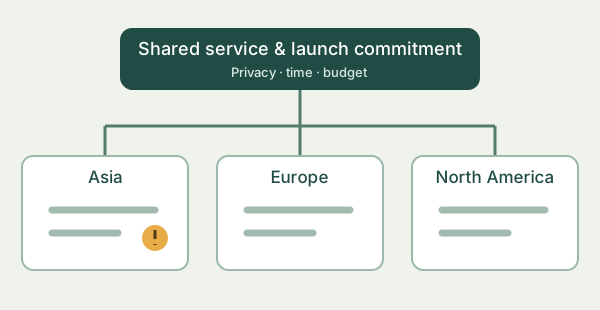
Plans for Asia, Europe and North America connect to one shared service and launch commitment, under privacy, time and budget constraints.
Three regional campaigns · one shared analytics response

Keep context with the plan

A change in one region.
A problem for all three?

Regional teams share an analytics service. A privacy change, a budget cut and a late prerequisite put different demands on the same response.

Add the three constraints in turn: two supplied responses become one, then none.

Explore milestones under changing constraints →
First comparison to try
  1. Keep shared-contract scope and Minimal policy. Select Observe an Asian privacy change: both supplied responses fit.
  2. Select North American contribution is cut: only aggregate reporting fits the budget.
  3. Select European prerequisite arrives late: neither response fits both bounds. One costs 6 units; the other takes 3 weeks. You have 5 units and 2 weeks.

The shared scope is an explicit scenario decision. This checks two supplied options; it does not rule out every plan or establish completed milestones.

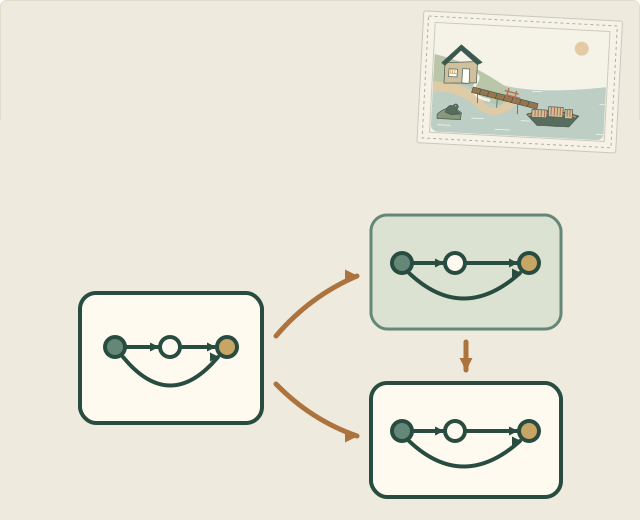
Two different model views on a project workbench
Illustrative scene; the experiments below state their own assumptions.

The wider enquiry

What must survive a change of view?

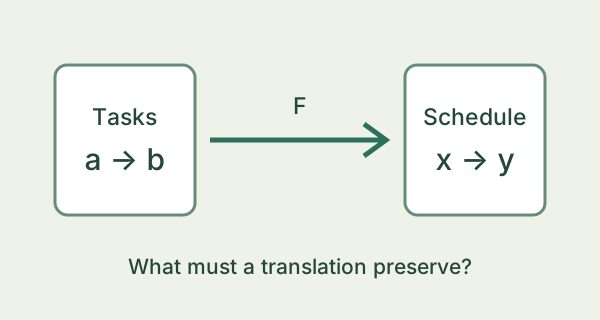
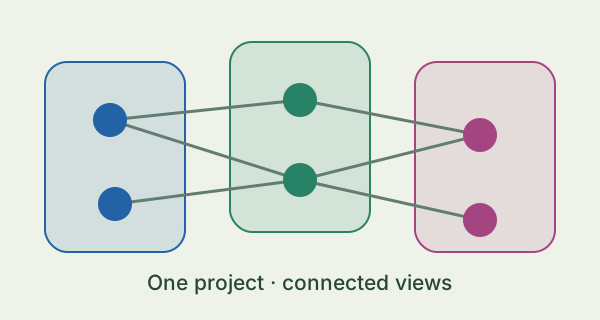
A delivery team has tasks and milestones; another view groups work into packages or records the states it produces. These small examples explore what survives when we translate or combine views. The collection also includes stand-alone mathematical teaching examples rather than one universal project model.

Which relationships must a change of view preserve?

All 16 experiments

The collection contains several constructions and teaching examples, not one verified model. Use the atlas explanation and project graph to explore proposed changes of view, or browse a particular idea below. Their relationship coverage is not a proof of functor laws.

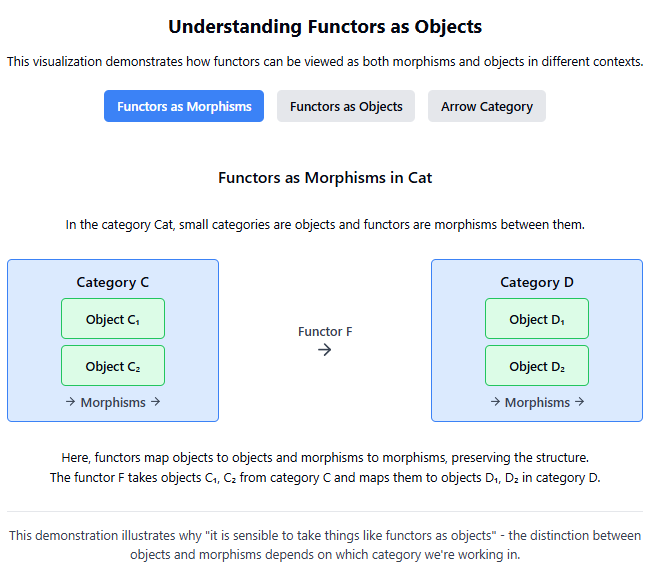
Functors as objects

Switch between Cat, a functor category and an arrow category to see when a mapping becomes an object.

functors, arrow category

Models and natural transformations

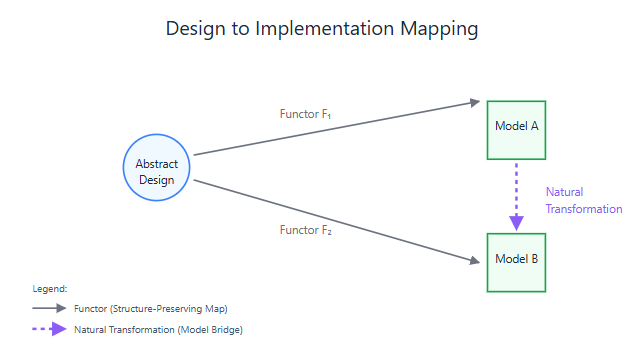
Select the design domain, two implementation models and their connecting arrows to explore the proposed model relationships.

operad, models, natural transformations, functors

The Island Reading Room: policies in conversation

Plan a delivery to an island reading room: compose two response policies, trace their dialogue, and hide the shared interface.

geometry of interaction, response policies, category theory, project management

Milestones under changing constraints

Trace privacy, time and budget changes through regional campaign plans; compare feasible shared-service responses and the limits of the fibration analogy.

fibration, milestones, context, project management, dependencies

Sheaf-style schedule playground

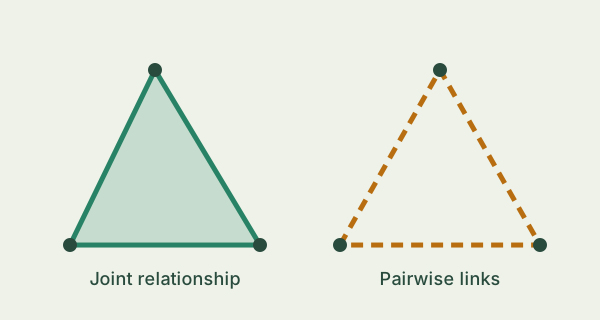
Change overlapping task-time assignments and resource caps to compare local agreement with schedule feasibility.

category theory, project management, sheaf, scheduling, visualization

Group actions for project thinking

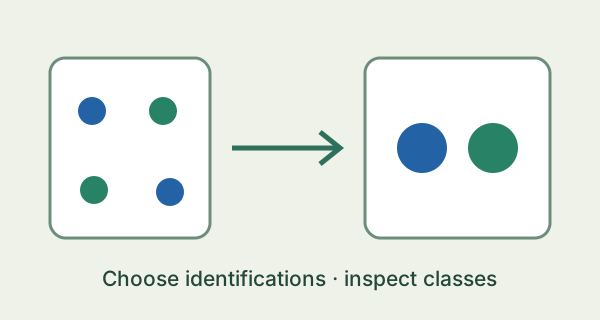
Toggle valid completion-state representations, follow rowmotion orbits and find a shortest sequence of reversible toggles.

group actions, project management, toggle groups, posets

Galois adjoints

Change a required capacity tier or commitment package and inspect the two-way translation in a toy rail upgrade.

category theory, adjoints, project management, visualization

Category theory construction toolkit

Choose a construction use case, then inspect the suggested categories and mappings between project representations.

category theory, construction, toolkit, systems

Composable uncertainty wiring

Change input intervals and compare serial, parallel and feedback propagation through power, cooling and footprint estimates.

category theory, uncertainty, wiring diagrams, co-design