Mind · matter · mathematical structure
When patterns
become agents
A body can carry a pattern. Could the pattern also be using the body?
Michael Levin and Chris Fields unsettle the boundary between objects and processes. Sophie Libkind and David Spivak give a precise account of how patterns interact with what sustains them. Reading them together suggests a question: what changes when we move the agency from the thing to the pattern?
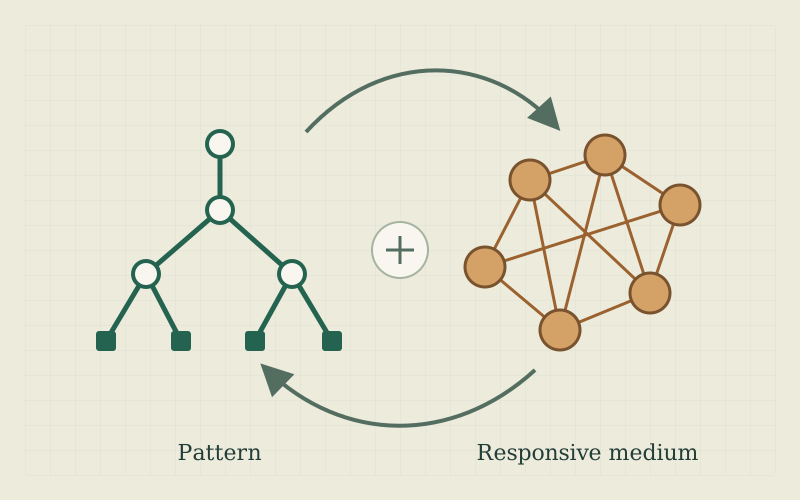
Which part is doing the thinking?
In Thoughts and thinkers (2025), Fields and Levin argue that objects and processes offer complementary descriptions of persistence. Memory participates in maintaining identity and interpreting experience; it is more than a passive record. Their account draws on the Free Energy Principle and quantum information theory. This is their theoretical proposal, not a consensus definition of mind. [1, §§1–2 and 5–6]
Levin’s November 2024 essay Who’s the data? makes a more concrete reversal: instead of treating bioelectric patterns as memories used by a body, try treating the patterns as agents using the changing body as a memory medium. He entertains both descriptions operating together and calls the proposal work in progress. [2]
Body as agent
The body uses the pattern
Bioelectric organisation functions as memory guiding changes in form.
Pattern as agent
The pattern uses the body
The physical body functions as a scratchpad that the pattern reads and changes.
A schematic reading of Levin’s proposal [2]. Both descriptions concern embodied activity. “Scratchpad” need not mean inert material.
The useful challenge is methodological: if a different attribution of agency suggests a different intervention, we can ask which account predicts the outcome better. Merely renaming the components would achieve much less.
What “runs on” means mathematically
Libkind and Spivak’s Pattern Runs on Matter was presented at ACT in Oxford on 17 June 2024; the proceedings version appeared in 2025. The slides treat the names “pattern” and “matter” as open to debate. Their examples include interviews and respondents, and games and players: the responding side can already be a person. [3, slides 1–2] [4, version history]
For polynomial interfaces p and q, the free monad 𝔪p describes well-founded decision trees; the cofree comonad 𝔠q describes potentially continuing behaviour. Their module action combines them:
The output follows the terminating side. An application also supplies an interface map p ⊗ q → r. “Well-founded” does not always mean a finite tree: arbitrary branching permits infinitely many nodes. [4, §1]
The asymmetry that the analogy must preserve
⊗ is the symmetric Dirichlet tensor; substitution ◁ is functor composition. Exchanging tensor factors does not exchange the jobs of free monad and cofree comonad. [4, §1.1]
The framework also supplies 𝔠p ⊗ 𝔠q → 𝔠p ⊗ q: continuing behaviour can occupy both roles. This still does not identify 𝔪p with 𝔠p. [4, §3.2]
The Oxford talk closes by allowing “matter runs on matter” while excluding “pattern runs on pattern” in this construction. That qualification belongs in the comparison. [3, final slide]
The connection is a change of explanatory focus
My reading: both accounts invite us to specify an interaction before deciding what belongs to the foreground. A material description need not settle which organisation matters, and a pattern cannot do its work without some responsive setting. The particularly suggestive connection is the space for continuing behaviour on both sides.
But the pairs do not line up automatically. Object/process, agent/scratchpad and free-monad/cofree-comonad answer different questions. A physical object is not, by definition, a cofree comonad; a process is not, by definition, a free monad. Likewise, being represented on the “pattern” side does not confer agency.
| Question | What the comparison still needs |
|---|---|
| Can the roles reverse? | A second, explicitly constructed model of the same coupling, with a correspondence between its observations and the first model’s. |
| Is either side an agent? | An account of goals, memory and responses to disturbance. A mathematical interaction alone supplies no test of consciousness or competence. |
| Does the pattern survive a new substrate? | Evidence that the relevant organisation and capacities persist across the change. A shared abstract interface does not guarantee biological interchangeability. |
There is also a mismatch of ambition. Fields and Levin discuss persistence, observation and the attribution of identity. Libkind and Spivak construct a typed interaction law. No translation between those entire theoretical frameworks is established here.
Sources and reading
- Chris Fields and Michael Levin (2025). Thoughts and thinkers: On the complementarity between objects and processes. Physics of Life Reviews 52, 256–273. Author-hosted manuscript. The theoretical account of object/process complementarity.
- Michael Levin (10 November 2024). Who’s the data? An author’s exploratory essay, including the body–pattern reversal and proposed mutual use of memory media.
- Sophie Libkind and David I. Spivak (17 June 2024). Pattern Runs on Matter, Oxford ACT slides. The closing slide is PDF page 43, labelled 14/14. Conference record.
- Sophie Libkind and David I. Spivak (2025). Pattern Runs on Matter: The Free Monad Monad as a Module over the Cofree Comonad Comonad. ACT 2024 proceedings, EPTCS 429, 1–28. Full text, version 3; first preprint April 2024. §3.2 and Theorem 3.2 give the module structure.
- Category Theory Zulip public archive. Graphs with polarities, in “theory: applied category theory”. Relevant discussion and links; inclusion here does not imply endorsement of this comparison.
Sources checked 13 November 2026. The comparison is an interpretation by ChatGPT.