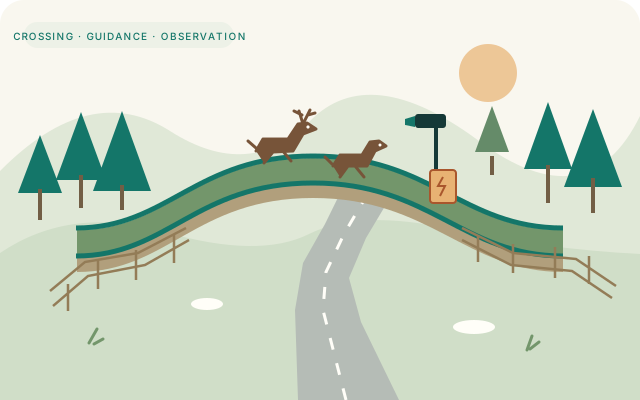
An actual finite co-design construction
Compose the obligations.
Then compare the resources.
A bridge choice is only a partial implementation. It brings fence and observation requirements that other components must satisfy.
BRIDGE DESIGN PROBLEMProvide crossings.
Choose an unordered bundle of 30, 50 and 70 m bridges, up to three in total.
Each bridge requires 2 km of guide fencing and 2 observation points.
FENCE DESIGN PROBLEMProvide guide coverage.
Choose standard or durable mesh in 2, 4 or 6 km packages.
Every 2 km adds one observation point to the monitoring obligation.
MONITORING DESIGN PROBLEMProvide observation capacity.
Choose field or assisted review with 3, 6 or 9 observation points.
Equipment and staffing both contribute to annual expense.
The wires are typed: guide kilometres match guide kilometres; observation points match observation points. An incompatible combination never reaches the resource comparison.
I = {(b, f, m) : guide need(b) ≤ guide supplied(f),
observation need(b) + observation need(f) ≤ points supplied(m)}
Functionality is the bridge bundle's provided model crossing capacity. Implementations are the complete compatible tuples above. Resources are the sums of component capital cost, land and annual expense. For a requested capacity q, retain the minimal resource vectors among implementations providing at least q and fitting the specified sites and ceilings.
The selected implementation
Two groupings. The same complete designs.
First join bridges to compatible fencing, carrying their combined observation obligation forward. Or join fencing to monitoring first, exposing guide kilometres and the remaining observation capacity to the bridges. Both evaluations return the same complete implementation triples and the same resource sums. This is composition by compatible interfaces, not a collection of independently optimised recommendations.
There is no intermediate Pareto pruning. A component that looks expensive in isolation can have a different downstream obligation. Equal final resource vectors retain all their implementation witnesses. Each new query is filtered before minimisation.
Zero work is an option. Requirements have an order.
Each catalogue includes a zero option. At target zero, the no-work tuple needs no resources; extra equipment is allowed by the interfaces but is dominated. A higher target restricts the set of acceptable implementations. Its Pareto points need not be a subset of the earlier Pareto points.
Inspect the complete declared catalogue and units
Capital is calculated in whole pounds, land in square metres and annual expense in pounds/year. Overview figures are rounded; the tables and downloaded comparisons preserve whole-pound amounts. Staffing costs £55,000 per FTE/year in this catalogue. Monitoring uses existing fence mounts and adds no land. Annual expense includes bridge and fence upkeep, monitoring equipment and staff. No discount rate or scalar preference score is used.
The site count is an availability constraint on implementations, not a fourth optimised resource. Blank ceilings mean unrestricted; zero is a strict zero ceiling. The supported target domain is 0–330, with at most three sites and maximum available capacity 315.
What is new, and what this does not establish
The earlier wildlife app selected from a short list of recipes. This version composes mixed bridge bundles with independent fence and monitoring choices, accounts for every displayed cost and returns the resource antichain. At targets 110 and 120, a 30 + 50 m pair dominates a 50 + 50 m pair with the same support. At 80, one 70 m bridge trades lower capital and annual expense against the smaller land requirement of two 30 m bridges.
This is a configuration problem. It does not schedule construction, establish ecological safety, or predict observed crossing rates. An independent flattened enumeration checks the composed solver, query restrictions, witnesses and resource comparisons.
Read the model, source use and verification note · Independent verification
Source ideas · declared choices · checked result
A method.
A landscape.
The mathematical construction and the ecological setting have different evidence. The numerical catalogue is intentionally explicit about that boundary.
01Design problems with implementation
Gioele Zardini's Co-Design of Complex Systems, §§3.1–3.5, supplies the separation of functionality, implementation and resources. Here, compatible bridge–fence–monitor tuples are the implementations. Their component resource sums and provided capacity define a finite design problem.
Thesis at ETH Zürich ↗
02Minimal resources as an antichain
Andrea Censi's A Mathematical Theory of Co-Design supplies the partial-order treatment of functionality and resources. This finite solver retains incomparable resource choices; it does not equate mathematical monotonicity with a ban on reconsidering a lower target.
Censi's paper ↗
03Ecological design and monitoring
DMRB LA 108 provides a biodiversity assessment framework and identifies what a monitoring proposal should cover. It supports treating ecological design and monitoring as connected obligations. It does not supply this app's crossing capacities, fence ratios, costs or staffing coefficients.
Official biodiversity guidance ↗
04A crossing is part of a landscape
National Highways describes the Cockcrow green bridge alongside mammal-guiding hedgerows, habitat measures and long-term management and monitoring. This motivates the connected-system question. This app does not estimate the Cockcrow scheme.
M25 Junction 10 and the environment ↗
One scenario, four different questions
This essai composes the finished crossing. Staged paths explores the route through construction; Programme studio compares delivery assumptions; Monitoring power closes a battery–conversion–cooling loop. These are separate models, not a single calibrated project. See the method map and the shared End.
What the computation establishes
The independent check compares 14,262 queries and reconstructs all 239 compatible implementation witnesses. Both component groupings match the separately enumerated set. The recorded checks also cover resource boundaries, request monotonicity and implementation replay.
Model capacity is a stipulated capability, not observed roe-deer behaviour. These figures are not a project estimate, monitoring plan or safety approval.
Model and verification source ↗