The library
Capabilities & futures
What capabilities do we need, and what might change?
Explore the practices, capabilities and tools a portfolio might need, with earlier reading, framework guides and clearly labelled future scenarios.
Examples, diagrams and reading sit together here. Dates and limitations belong to each piece; an earlier illustration is not a claim of current practice.
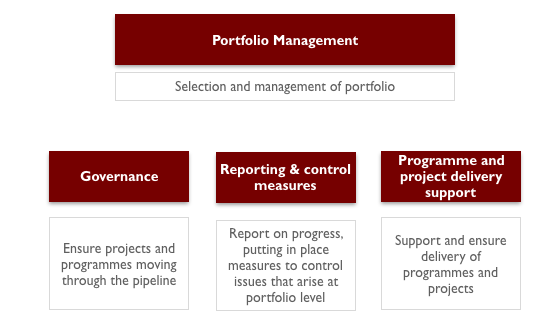
Earlier method · Portfolio management
Which working practices does this portfolio need?
A guide to choosing and adapting frameworks. The linked public code repository now retains a navigational skeleton, rather than the former full toolkit.
Interactive example
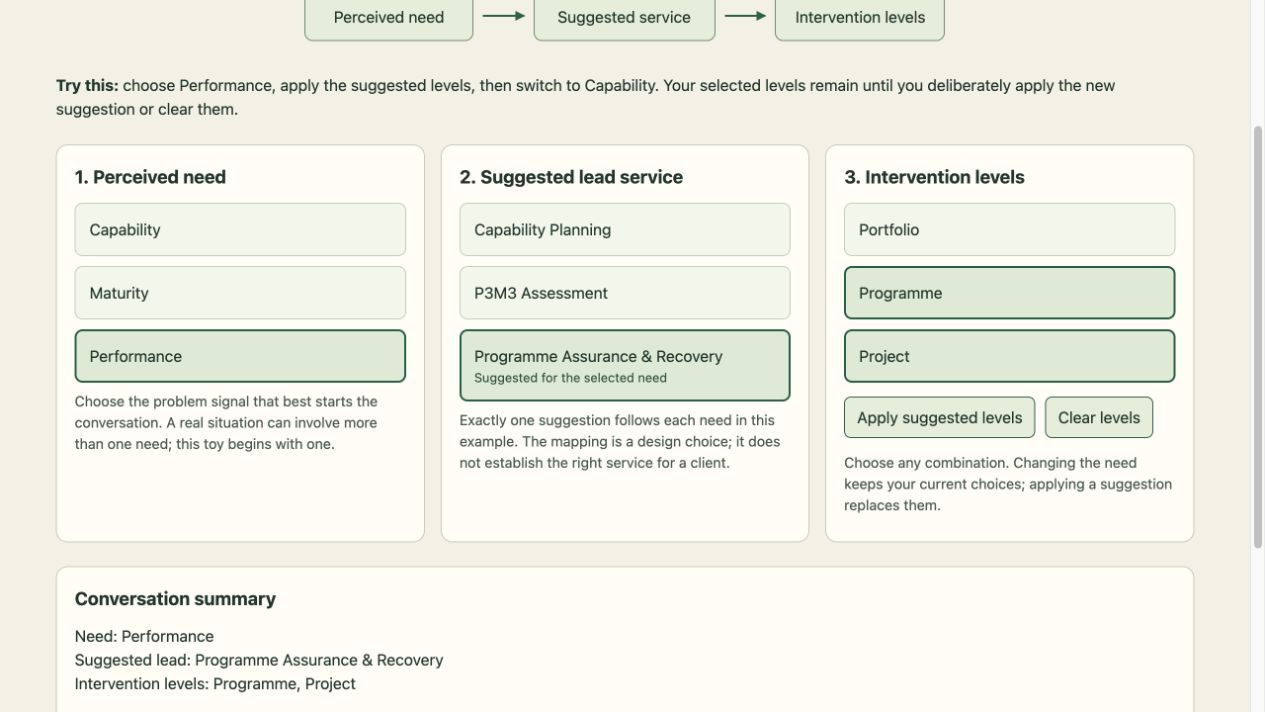
Separate capability, maturity and performance
Use a perceived need to suggest one lead service, then choose the portfolio, programme or project levels to address.
What to try & what it leaves out
Try. Choose Performance and apply its levels, then switch to Capability. Compare keeping those levels with applying the new suggestion.
Limits. A fixed conversation heuristic; it does not diagnose a project, perform a P3M3 assessment or validate a service’s suitability.
Earlier example, repaired and reviewed 2 October 2026. This review checks the stated model and interactions; it does not establish usefulness in practice.
GitHub source (may require access)Historical article ·
Project management: Some jobs to be done
Project information needs and the management jobs that information should support.
Interactive example
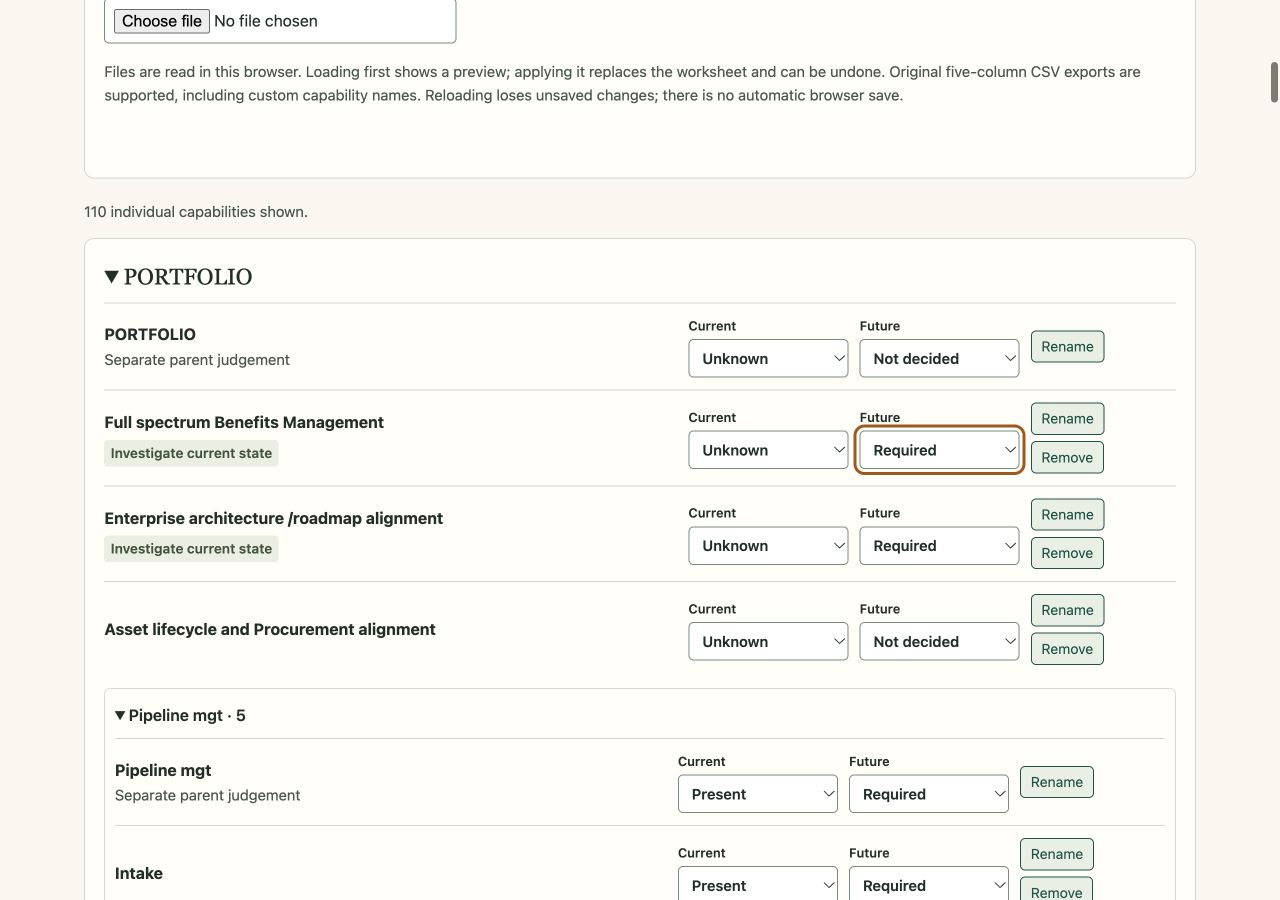
Review portfolio-office capabilities
Assess an editable hierarchy of portfolio-office capabilities, separating confirmed gaps from unanswered questions.
What to try & what it leaves out
Try. Change a current and target assessment, inspect coverage and gaps, then export and reopen your edited hierarchy.
Limits. An authored checklist and fictional example, not P3M3 or a validated maturity assessment.
Earlier example, repaired and reviewed 2 October 2026. This review checks the stated model and interactions; it does not establish usefulness in practice.
GitHub source (may require access)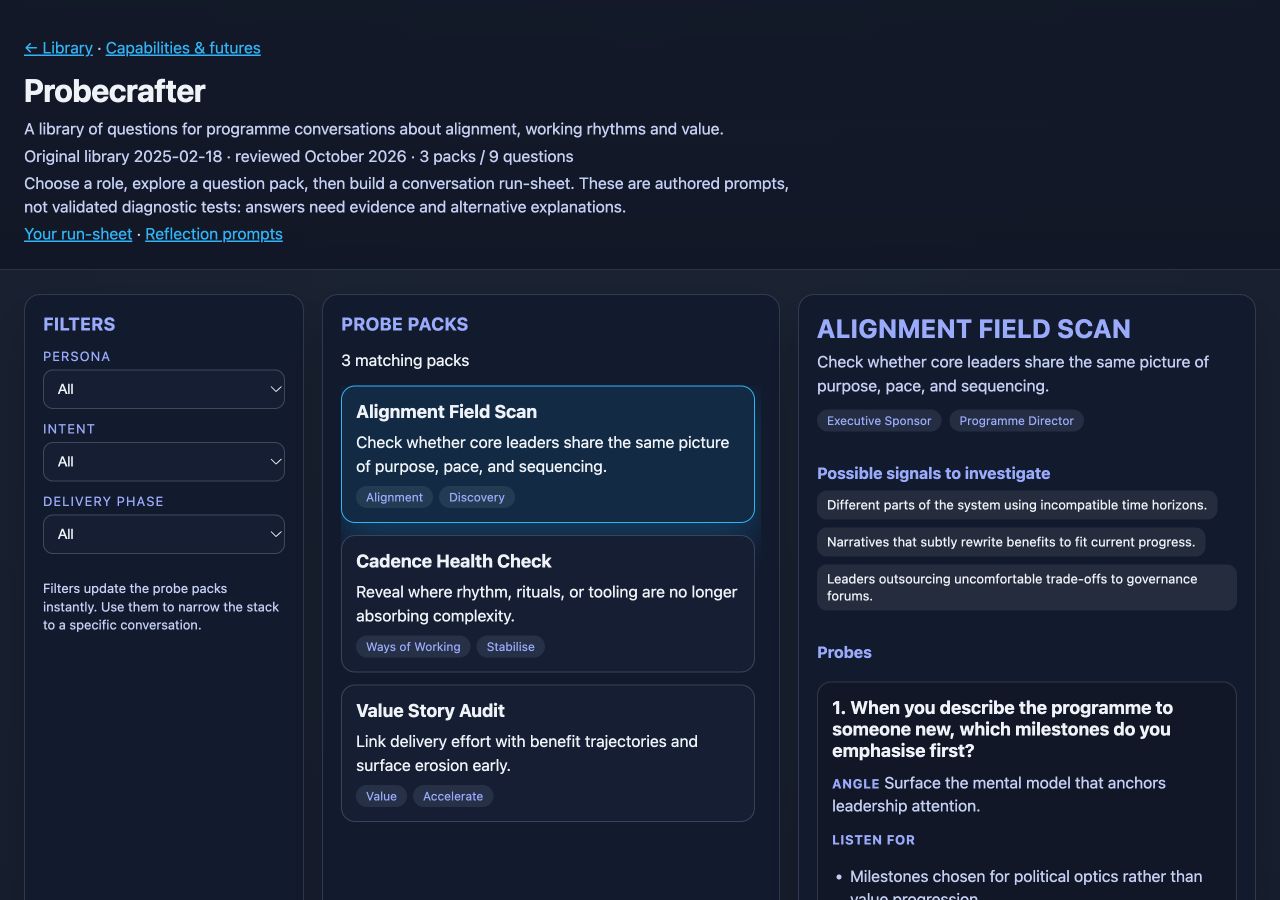
Interactive example
Build a more useful programme conversation
Choose questions about alignment, working rhythms and benefits, then assemble a portable run-sheet.
What to try & what it leaves out
Try. Filter by role, add questions from two packs and reorder them. Reopen the run-sheet with its follow-ups and coaching notes.
Limits. Authored facilitation prompts, not a validated diagnostic or causal test. Answers need evidence and alternative explanations.
Earlier example, repaired and reviewed 2 October 2026. This review checks the stated model and interactions; it does not establish usefulness in practice.
GitHub source (may require access)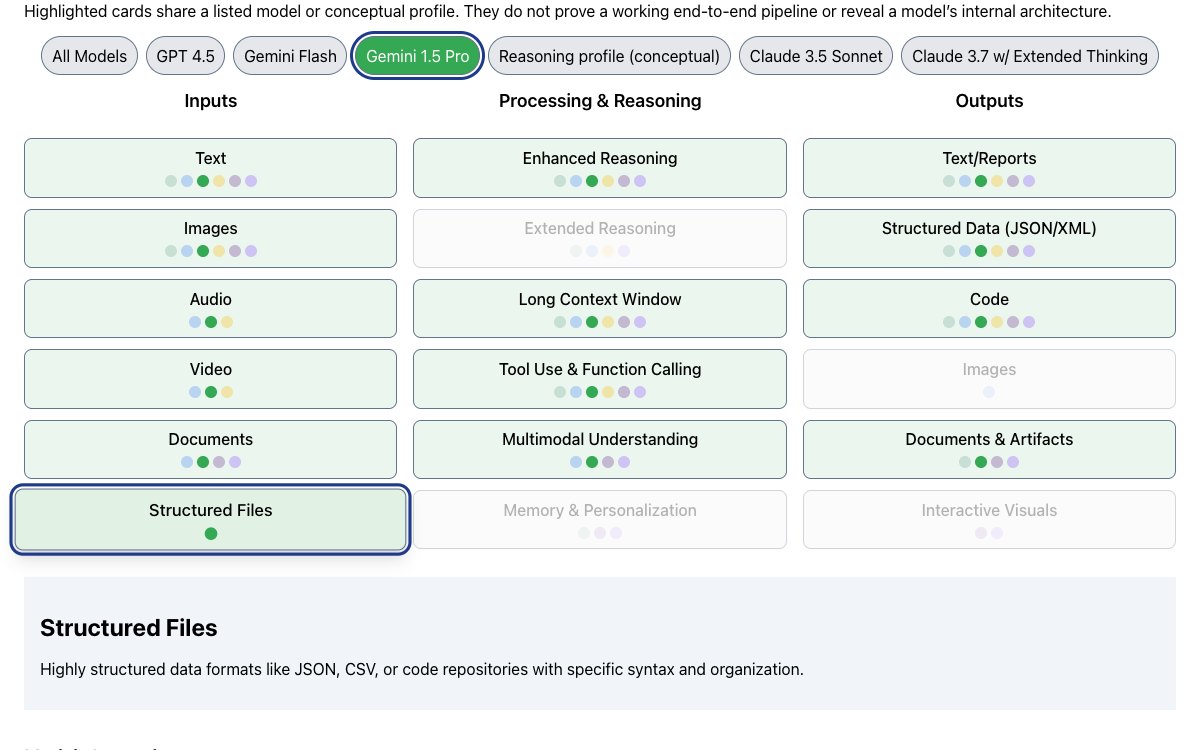
Interactive example
Match a task to a capability
Explore an earlier proposal for connecting task needs with AI capabilities and model choices.
What to try & what it leaves out
Try. Focus or select a capability, read its description, and follow its connections.
Limits. A historical conceptual map, not a current model ranking, benchmark or proof that the suggested combination works.
Earlier example, repaired and reviewed 2 October 2026. This review checks the stated model and interactions; it does not establish usefulness in practice.
GitHub source (may require access)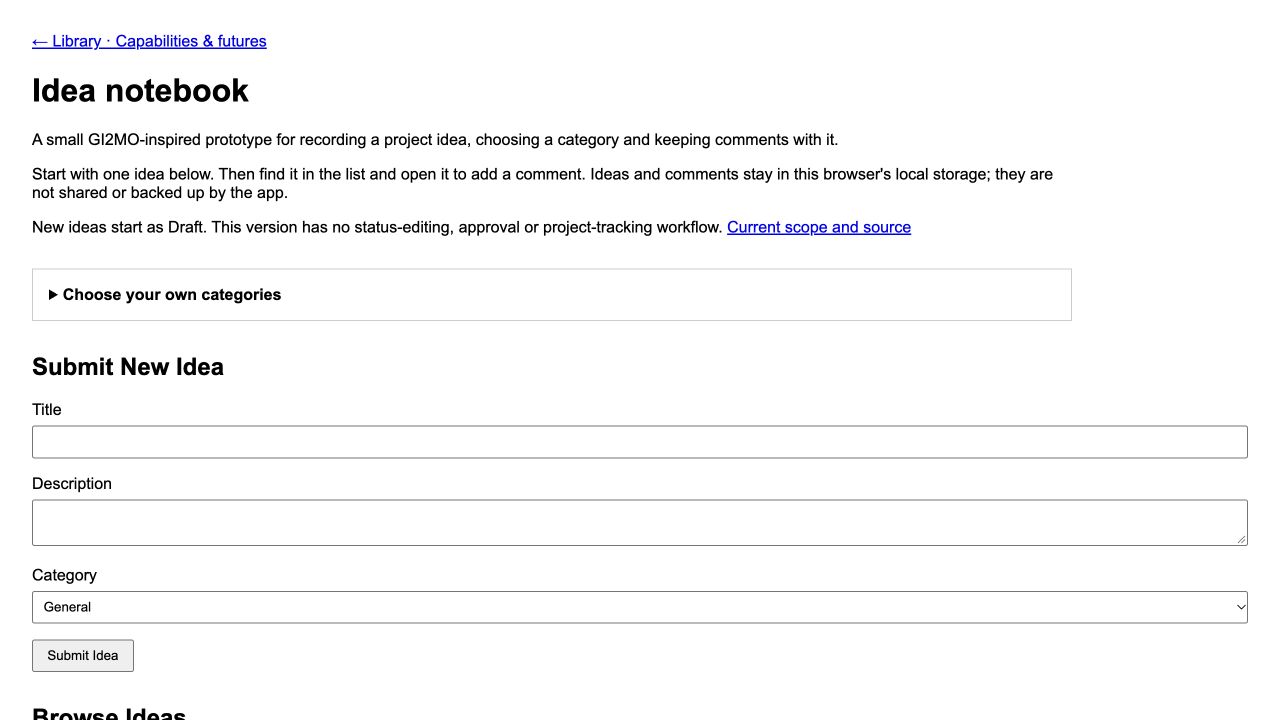
Interactive notebook · GI2MO-inspired prototype
Idea notebook
Record project ideas and comments with your own categories. Reopen the same notebook to continue working with your saved entries.
What this example leaves open
Browser-local ideas and comments. No shared review, approval or project-tracking workflow.
Historical article ·
Adopt existing portfolio framework
Choosing and adapting a portfolio-management framework. Reading guidance revised in September 2026.
Interactive reference map
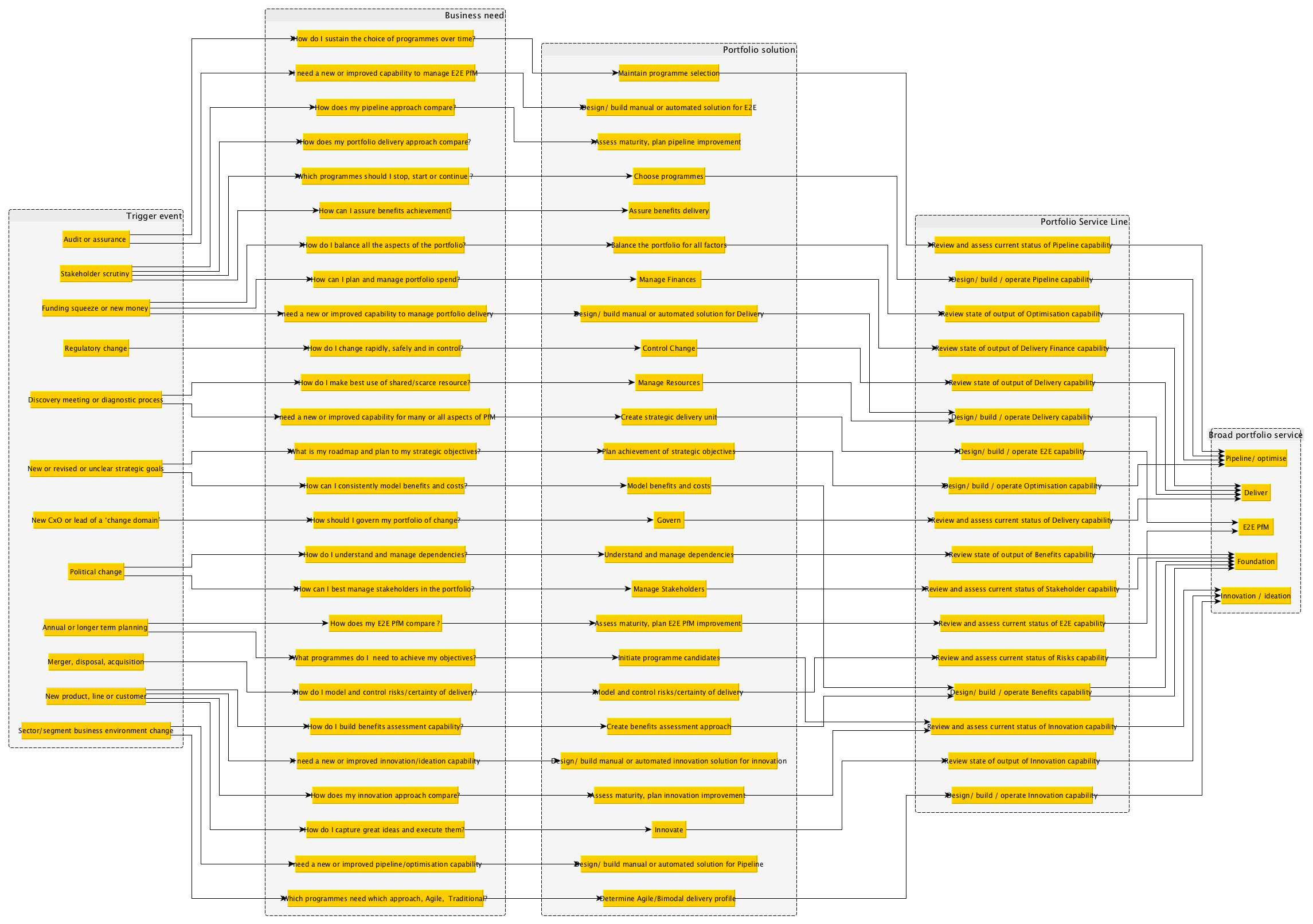
Gap Map
Inspect an earlier map of project-management gaps and proposed capabilities, and follow the connections to supporting resources.
Interactive example
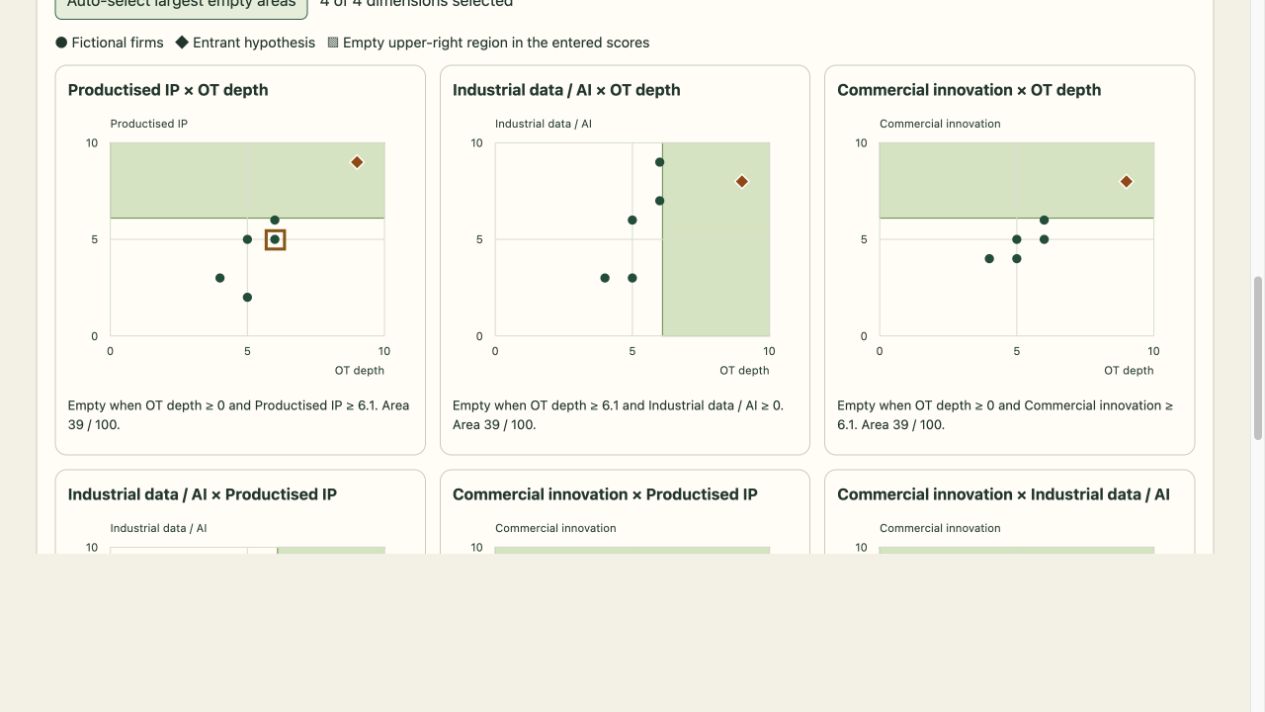
Explore gaps in a capability map
Edit six capability scores for five fictional firms, compare six pairwise plots and position an entrant in the empty regions.
What to try & what it leaves out
Try. Raise two scores for one firm to 10, then lower one. Watch the empty upper-right region close and reopen before moving the entrant sliders.
Limits. Invented scores and a 0.1-grid geometric search. Empty areas do not establish demand, feasibility, competitor capability or a commercial opportunity.
Earlier example, repaired and reviewed 2 October 2026. This review checks the stated model and interactions; it does not establish usefulness in practice.
GitHub source (may require access)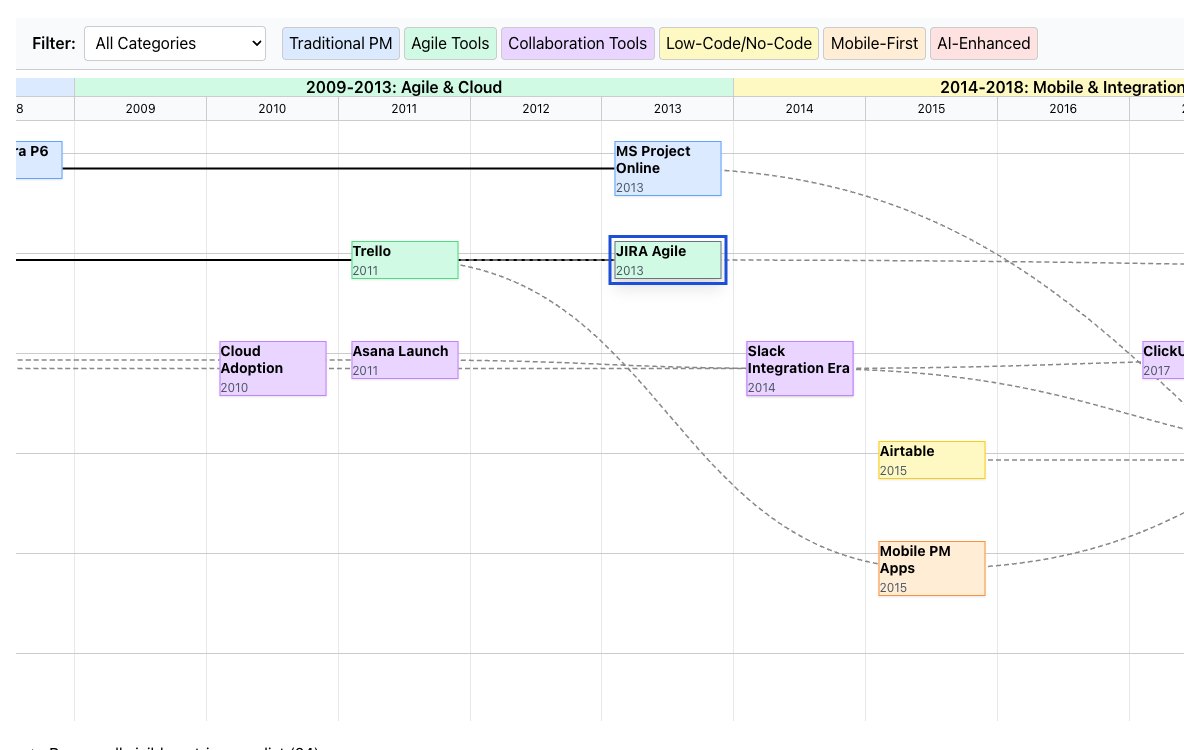
Interactive example
Follow the changing project-tool landscape
Read a sourced software timeline and a corrected 2010–2025 controls comparison, separating interpretation from evidence.
What to try & what it leaves out
Try. Trace a milestone, then compare the controls diagram and inspect its placement assumptions.
Limits. Selected events and an interpretive arrangement; connections are not evidence of product inheritance or a forecast.
Earlier example, repaired and reviewed 3 October 2026. This review checks the stated model and interactions; it does not establish usefulness in practice.
GitHub source (may require access)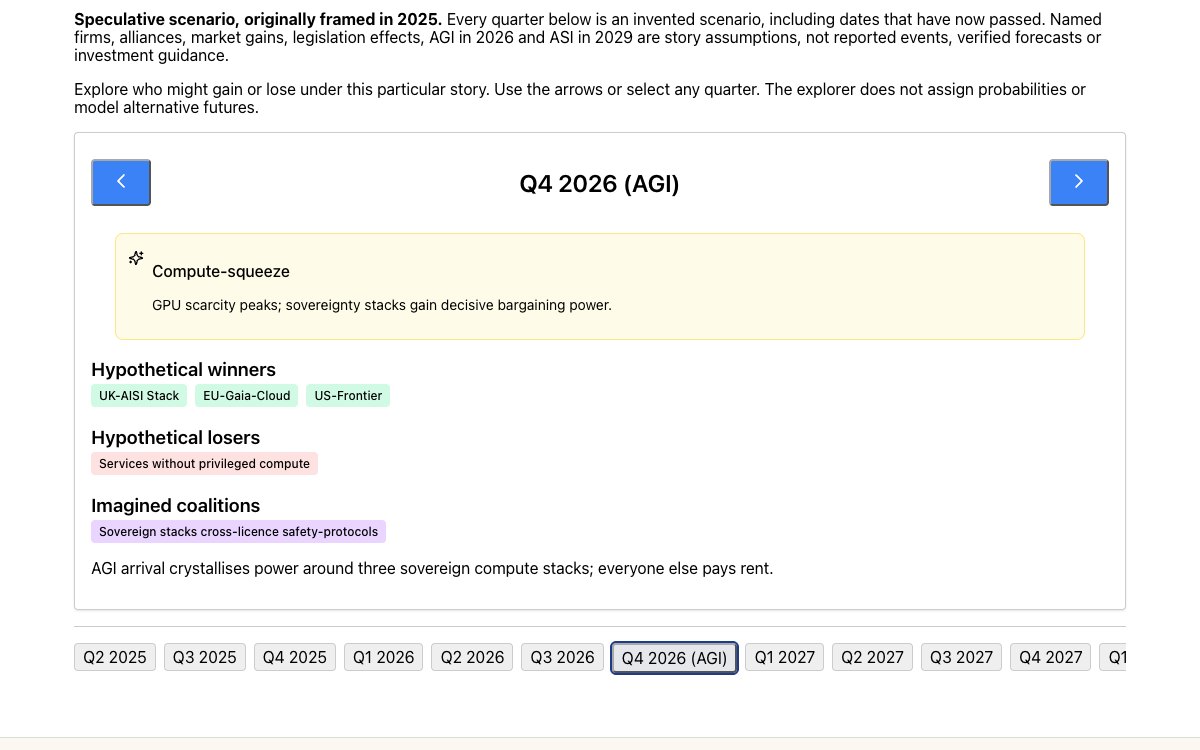
Interactive example
Imagine different project-services markets
Compare three dated, authored stories about project-services markets, including their fictional archetypes and strategic questions.
What to try & what it leaves out
Try. Choose a story, move through its periods, and compare its assumptions with the alternatives.
Limits. Preserved authored scenario narratives, not forecasts or evidence that a dated AGI, ASI or market event happened.
Earlier example, repaired and reviewed 3 October 2026. This review checks the stated model and interactions; it does not establish usefulness in practice.
GitHub source (may require access)Earlier reading list
Books
Reading on organisational change, innovation, learning and working methods, alongside earlier books on technology and data science.
Background report · April 2025
Deep Research
A retained report on project gaps, capabilities and resources, with a direct PDF link and a readable report page.
Interactive example
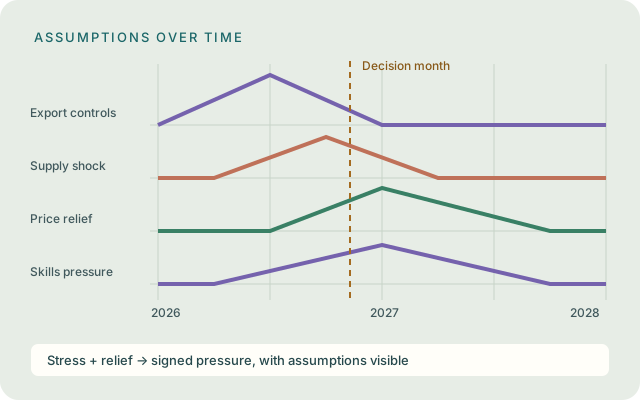
Compare overlapping scenario pressures
Place authored policy, market and technology scenarios across time and inspect their signed effects on project constraints.
What to try & what it leaves out
Try. Shift a scenario window and compare pressure at a milestone; inspect the opposing effects behind a small net value.
Limits. Authored triangular activations and signed effects, not probabilities, calibrated forecasts or a robust optimisation method.
Earlier example, repaired and reviewed 3 October 2026. This review checks the stated model and interactions; it does not establish usefulness in practice.
GitHub source (may require access)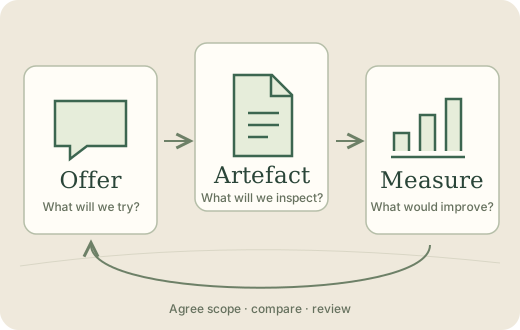
Interactive example
Shape a useful project service
Turn a service option or use-case question into a scoped artefact, a human review and a testable measure.
What to try & what it leaves out
Try. Compare an ordinary offer with an AI-assisted option, then inspect the evidence needed to know whether either helps.
Limits. Design prompts and candidate measures, not a vendor catalogue, delivered capability or demonstrated performance.
Earlier example, repaired and reviewed 3 October 2026. This review checks the stated model and interactions; it does not establish usefulness in practice.
GitHub source (may require access)