Enough can be less.
“East is available” can group east-only and both-open together. Both permit an eastward move. Full identification of the layout is unnecessary for this choice; one undifferentiated instruction is insufficient.
 Knowing enoughto act together
Essai 01 · Moving the whale · 2 October 2026
A route exists. The people making the move see different parts of the situation. What must they know to act together?
Try the first move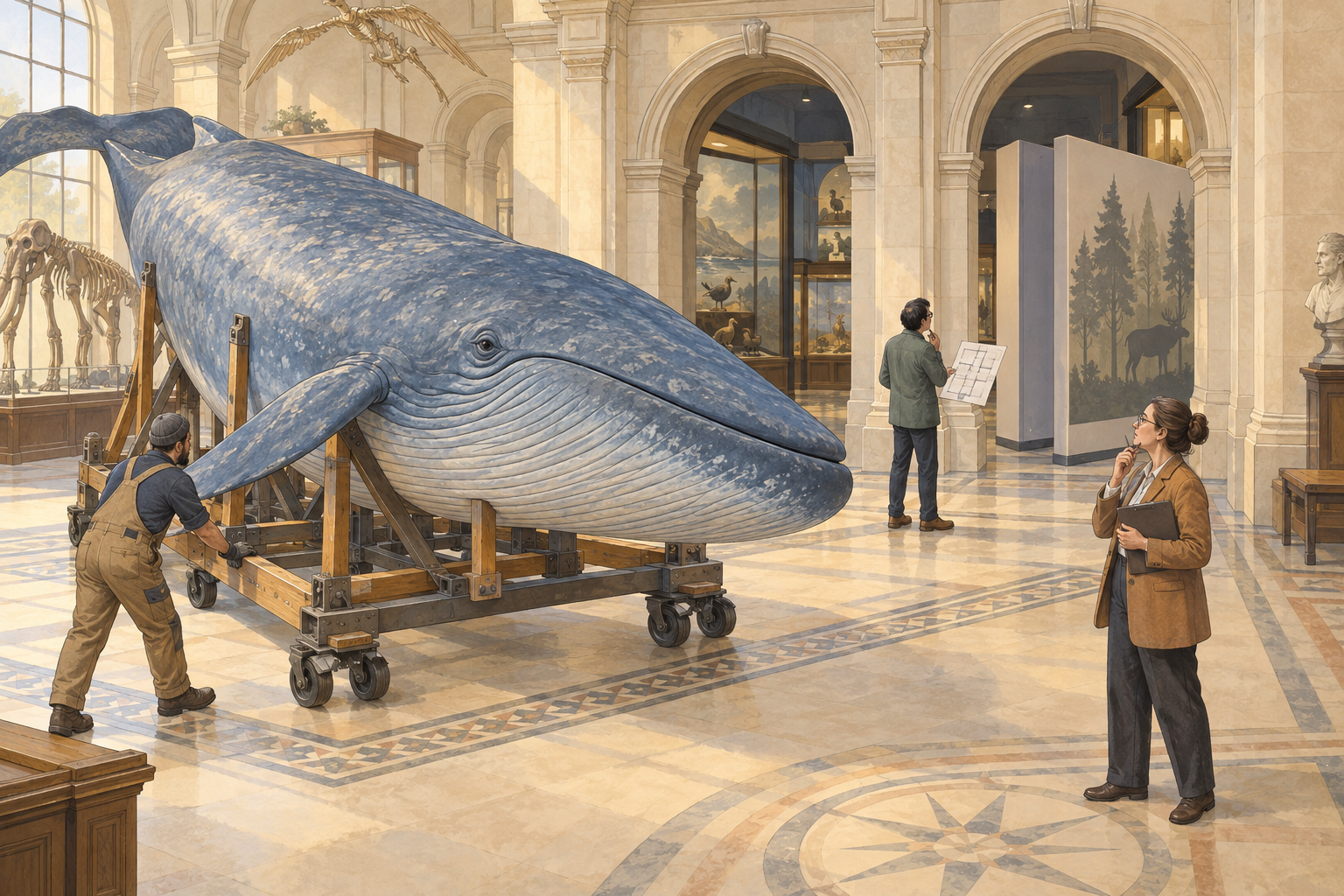
The small project
A museum is rearranging a gallery before reopening. Its oversized whale exhibit must pass through an east or west passage. The survey team has checked the layout. The handling team chooses the passage. Later, the curator decides whether to reopen.
Everyone wants the same outcome, tells the truth and understands the agreed signals. Authority to move is already granted. Still, an available route or a finished move does not automatically become information the next person can use.
The kind of question this foray asks
Two situations can look identical to a person yet call for incompatible actions. That is where information work has a job to do.

First result: three possible layouts need only two distinguishable instructions. Knowing enough to act can be less demanding than knowing exactly which world you are in.
The working experiment
Choose what information work is in place. The checker groups all admitted cases by what each person observes, then looks for a decision that works throughout each group.
01 / Choose a passage
Exactly three layouts are admitted: east only, west only, or both passages usable. A handler must choose one usable route. Waiting forever does not satisfy this decision task.
02 / Decide whether to reopen
At a later checkpoint, the move may be complete or still underway. The curator must reopen in the complete cases and hold in the underway cases. Holding every time avoids an unsafe reopening, but fails this more demanding brief.
03 / Look through different eyes
Each card is an admitted possibility; only the outlined card is selected as actual. The curator’s view never receives the modeller’s chosen-case selector.
Work derived from the declared choices
The checker tries every subset of these six available interventions. It returns all equally cheapest arrangements that meet the selected brief in every admitted case.
Smallest means least total effort in this menu, with these prices and assumptions. The survey, permission and physical move are supplied parts of the scenario.
All five partitions of the three layout possibilities are checked separately. For each observation group, the intersection of acceptable actions must be nonempty.
Read the executable model · Read the testsWhat this first essai found
“East is available” can group east-only and both-open together. Both permit an eastward move. Full identification of the layout is unnecessary for this choice; one undifferentiated instruction is insufficient.
A received truthful completion report lets the curator distinguish complete from underway. If a report can still be missing, silence leaves those possibilities entangled. A physically finished move can remain unrecognised.
With uncertain delivery, a received acknowledgement can tell the handlers that the curator knows. It does not repair a report that never arrived. With delivery already guaranteed by the checkpoint, that extra receipt is unnecessary for this model’s knowledge goal.
A careful table can solve this small example. The contribution here is an explicit, reusable check: keep a person’s indistinguishable cases together, intersect their acceptable actions, and return either a local rule or the conflicting cases. Enumerating repairs makes the cost of a stronger coordination brief visible.
This is a first construction for the wider enquiry—not a discovery of a new logic, a general project planner, or evidence that the tool improves real projects.
The bridge back to the foray
End: understand when project participants can jointly act from their different information, and derive useful information work where possible.
Ways: epistemic planning provides states, observations and locally informed choices. Distributed cognition asks how the arrangement of people and artefacts changes that work.
This essai: an exact finite check at two supplied decision points, with an exhaustive search through a small information-work menu. Read the public foray prompt.
Possibilities linked by what a participant cannot distinguish. We implement that as equality of explicit local observations. A Gentle Introduction to Epistemic Planning, §6.
A participant cannot choose differently between cases their own information leaves identical. We borrow that discipline; we do not implement their full planning and perspective-shifting algorithm. Cooperative Epistemic Multi-Agent Planning, §3.3.
Necessary conditions for an action can impose necessary knowledge conditions. Our finite intersection argument is checked directly; the paper’s broader theorems are not transferred wholesale to asynchronous human work. The Knowledge of Preconditions Principle, §§2–3.
What can be known depends on the protocol, timing and delivery assumptions. Our model states these explicitly and distinguishes a received message from knowledge at its sender. Knowledge and Common Knowledge in a Distributed Environment.
A shared artefact can change the cognitive work required. This motivates looking beyond “send more data”; no claim about real human performance is inferred from the finite checker. How a Cockpit Remembers Its Speeds.
The layouts, observation rules, truthful reports, response checkpoints and effort costs are authored. The model chooses safe route decisions and appropriate reopening decisions; it does not simulate handling equipment, prove that the move eventually finishes, model fatigue or misunderstanding, or guarantee real-world safety. The completion channel may miss a checkpoint; route cues are assumed available beforehand.
The first gain is modest but concrete: information arrangements now produce checked local decision rules and specific counterexamples. Whether that representation pays its way in larger project work remains an open question.