← CompareTHE FOOTBRIDGE TRIALMethods & evidence

ONE RECOVERY PROJECT · NINE DIFFERENT QUESTIONS

A crossing to restore.
Nine ways to reason.

Two deck sections need placing, inspecting and accepting before a footbridge can reopen. Access to the river is constrained. What can each approach reveal?

A fictional recovery project inspired by the collapsed footbridge at Gimårasten on the Gimån, near Stavre. The construction methods, conditions and figures below are invented; this is not an assessment or repair proposal for that bridge.
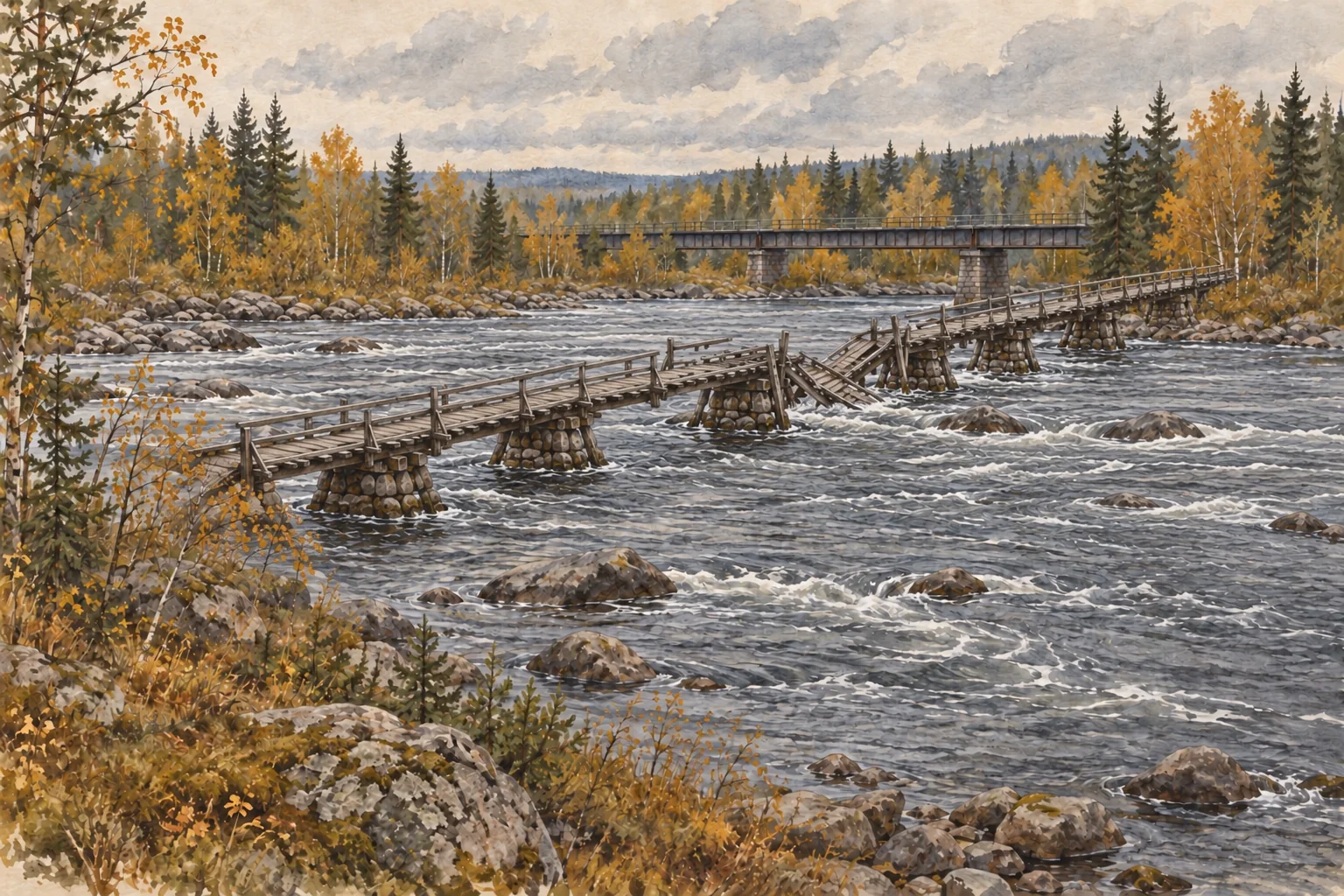
An illustrated broken timber footbridge across a broad autumn river, with a railway bridge behind
Gimån, imagined. Place and picture.

THE VIEWS, SIDE BY SIDE

What changes when access disappears?

The matrix holds the shared evidence and capacity settings fixed, then removes the low-water work window. Each row answers its own question; the counts are not scores.

Change the shared conditions

Baseline: low-water access and both evidence prerequisites supplied; one lifting resource.

The common brief and its boundaries
ABtemporary works → accepted crossing
The two-section replacement assumed by these small models.

The crossing is closed. Assume damaged material has already been made safe and removed, the abutments can support the declared recovery method, and two standard replacement sections are available to prepare. Placement uses temporary supports. The ordinary route needs a low-water work window; a bank-based alternative is included only where stated. Condition evidence and permission are independent supplied prerequisites, not conclusions generated by a plan.

The co-design example varies the deck configuration and uses a 70-unit illustrative budget, a load-rating floor of 10, and invented mass, duration and site-occupation units. The state example separates installation, curing, inspection, clearance and reopening. Other examples deliberately aggregate some of those steps. Logical moves, schedule durations, calendar months and decision opportunities are separate abstractions.

No dimensions, hydrology, structural performance, real permissions or costs for the actual bridge are established here. A successful calculation supports only the declared small model. The optional survey in the decision example concerns extra logistical readiness and cannot replace required structural-condition evidence.

Which approach fits your question?

Return to the comparison for the wider collection and its current “best for” judgements. The nine trials here provide inspectable evidence for particular uses.