Foray 240
Meta Project Innovation
Scenario
Foray 240 · A higher-autonomy enquiry
Project Frontier Lab
Toy scenario
The island observatory has been shut for years. Its dome is damaged, its notebooks are damp, and the regular ferry stops in 28 days. The community wants one public observing weekend. How much of the grand restoration really has to happen first?
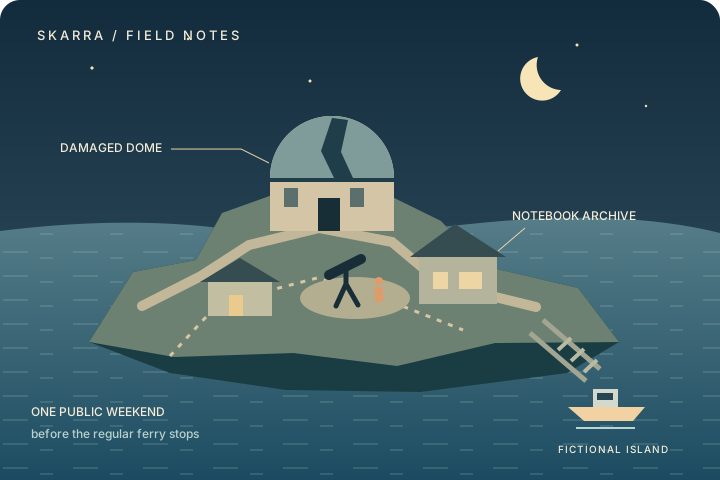
The project in question
Open a weekend. Or restore an institution?
The trustees proposed restoring the dome, digitising the whole archive, installing permanent power and building a booking system. The visitor outcome is narrower: an observing evening, a small protected notebook display, a refuge and an agreed return journey.
- Outcome
- A physical public weekend
- Access
- 28 planning days remain
- Existing assets
- Museum ticketing · hired telescopes
- People
- Volunteer crew · scarce specialists
Purpose
The enquiry behind the trial
End. Meta Project Innovation asks AI for genuinely different project enquiries, judged for value, feasibility, surprise and innovation. The existing forays convey the ambition and originality to seek; their ingredients are not a menu to rearrange. This trial is one early candidate to examine.
Concept. The July 2026 run proposed a Demand Destruction Engine, Truth-Sensor Planning and a Project Capability Compiler. Each now has a worked lens, a concrete output and a limit. The original proposals and preservation map retain their wider possibilities and pilot designs.
Construction. The Skarra observatory tests outcome fidelity, evidence decay and reusable procedures. Six lenses share a current ledger; the compiler consumes demand and evidence, while whole-package allocation, typed paths and schedule heuristics remain independent. Its deadline check is a duration comparison, not a tidal or weather forecast.
Limit. Software checks cover the stated calculations; they do not demonstrate a better project choice or a delivery benefit. The wider foray ambition remains unfinished.
Essai 1
Project Frontier Lab
The first three lenses develop the three proposals from the July 2026 run. Demand and evidence settings feed the compiler. Scarcity, dependencies and scheduling retain their separate models; there is no single combined optimum. Read the wider enquiry.
Challenge the demand
The original Demand Destruction Engine asks whether the outcome needs the proposed project at all. Start with three genuinely different routes; then challenge the inherited demands and leave a decision receipt.
Effort points are relative workload units, not cost or duration. A fixed multiplier estimates immediate commitment. Later implementation and replacement work is not costed. The separate route comparison exposes test delay and irreversible commitment. Mandatory obligations stay visible when their proposed solution changes.
Route minimums: weekend 10 days, full restoration 35, remote night 3. A small test takes 2 days plus boat-negotiation time. These independent route estimates do not reschedule the task model. Remote observing changes the agreed outcome; reducing cost does not make it equivalent to reopening.
| Demand | Why it exists | Effort | Disposition |
|---|
See the relative effort assumptions
Delete × 0; shrink × 0.45; substitute × 0.35; standardise × 0.55; automate × 0.65; test first × 0.20; negotiate × 0.50; reuse / combine × 0.30; proceed × 1. The multipliers express workload assumptions. A lower commitment does not demonstrate that the need or obligation has been met.
Inspect the decision receipt and rejected alternatives
Physical constraints, negotiable arrangements and preferences are recorded separately. The receipt retains unresolved obligations and alternatives that remain viable; it does not pretend the selected route has won.
Make plan claims testable
A completed activity is not the same as current evidence; evidence is not the same as a supported claim; and a supported claim is not an approved gate.
Truth-Sensor Planning links a claim to an observation that could disprove it and an action to take. The thresholds belong to this model. A completed chain earns review, not permission to open.
Selecting “current” records a new observation today and clears reviewer acceptance. Threshold and activity remain separate. “Silent” means expected evidence failed to arrive; “contradicted” means evidence against the claim. Time automatically makes current evidence stale. This evidence clock and the remaining-access window are separate what-if inputs; advancing it does not reschedule the other lenses.
| Claim and sensor | Activity done | Evidence | Threshold met | Reviewer accepts | Chain state |
|---|
Compile what the project taught you
The Project Capability Compiler turns a decision, reversal or failure into a method another team can actually try. It reads your demand and evidence settings; change those and an old packet becomes stale.
A deterministic compiler packages the supplied material. It does not discover a validated lesson, train a model or prove a marketable offer. The transfer test rehearses the packet’s conditions.
Allocate scarce expertise in whole packages
Teams disclose the outcome unlocked, cost of waiting, confidence in that claim, minimum useful package and a credible alternative. The protocol allocates days.
A greedy heuristic ranks a score per day, then funds each whole package that fits. It can leave a better combination unfunded; it does not find a general optimum.
| Demand | Delay cost 1–10 | Evidence 0–100% | Minimum days | Alternative |
|---|
See the allocation rule
Score per day = (delay cost × confidence / 100 × alternative factor + reuse × 0.55) / minimum days. The alternative factor is 1.15 for none, 1 for partial and 0.82 for yes. Fixed reuse points: S1 = 4, S2 = 2, S3 = 3, S4 = 5. Ties retain S1–S4 order. A skipped package does not consume capacity. Zero confidence removes the delay term but leaves the assumed reuse term.
For example, with 4 days, a 3-day package scoring 3 per day is picked before two 2-day packages scoring 2.5 each: its total score is 9, while the pair would score 10. A ranking is a discussion aid, not a proof of the best allocation.
Inspect typed, directed dependencies
Precedence, evidence, approval and feedback links mean different things. A directed precedence cycle makes a schedule infeasible; a feedback loop may be useful learning; a second evidence path may be resilience.
These are structural path checks, with the unavailable node removed. A path does not establish that all prerequisites, evidence or approvals are satisfied. The schedule in the next lens uses a separate fixed graph.
Read the network without the diagram
Path tests include only their stated types. Feedback links are excluded from release paths and precedence-cycle checks. Each link can be enabled or disabled independently above.
Run a transparent planner tournament
Five declared heuristics schedule eight dependency-constrained tasks under a base case and two duration stresses. Each task uses one workstream until it finishes. The app compares the resulting schedules.
Lower regret is better under this score. Regret compares only these five heuristics in each scenario, then averages the three differences equally. “Balanced” is a weighted priority rule; no robust optimisation or calibrated forecast is implemented.
| Policy | Average regret | Base finish | Base first assumed outcome | Base unresolved uncertainty at day 6 | Base reuse by day 6 |
|---|
Base-scenario schedule
See the policy rules and scenario changes
At each finish time, all completed tasks release capacity; eligible tasks are ranked using their scenario duration. Ties use task ID order. Tasks are indivisible, never pre-empted and start as soon as capacity and all predecessors allow. A task marked “outcome” is assumed to yield its outcome when finished; the app does not test actual validation.
- Risk-first: 2 × risk + uncertainty − 0.2 × duration.
- Value-first: 2 × value + 0.4 × risk − 0.2 × duration.
- Learning-first: 2 × uncertainty + 0.5 × risk − 0.2 × duration.
- Reuse-first: 2 × reuse + 0.4 × value − 0.2 × duration.
- Balanced heuristic (formerly “Robust balance”): risk + value + uncertainty + reuse − 0.45 × duration.
Scenario score = 2 × finish day + 3 × first outcome day + 1.2 × unresolved uncertainty at day 6 + 0.18 × Σ(risk × task finish day) − 0.65 × reuse completed by day 6. Uncertainty is the sum of points on all unfinished tasks, not a critical-path measure; reuse is credited only on completion.
Damp-archive stress adds 2 planning days to P1 and 1 day to P3. Access-repair stress adds 2 planning days to P2 and 1 day to P7. These changes are known to the scheduling rule before it starts; this is not adaptive replanning after a surprise.
| Task | Predecessors | Duration | Risk | Value | Uncertainty | Reuse | Outcome |
|---|
Current decision ledger
A current summary of each lens, its assumptions and next decision trigger. The compiler reads demand and evidence. The remaining models are independent; this ledger is recalculated, not an immutable history.
| Lens | Current reading | Evidence basis | Remaining uncertainty / next trigger |
|---|
Keep or restore your experiment
Export the current settings as JSON, then copy the text somewhere safe. Paste it back to restore all six lenses and the selected view. Nothing is stored automatically. Version 2 identifies the Skarra case and preserves compiler settings and rechecks its source receipt; a stale receipt is discarded on import. Outputs are recalculated; no operational files are stored. Old cloud-case snapshots are rejected with an explanation, never silently reinterpreted.