A source-to-enquiry reading map
Portfolio Wave reading map
Scenario
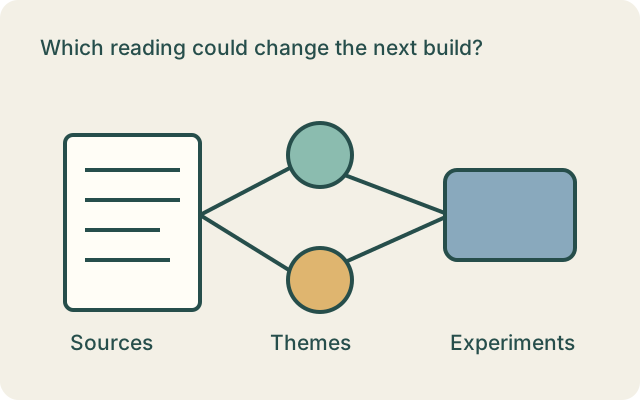
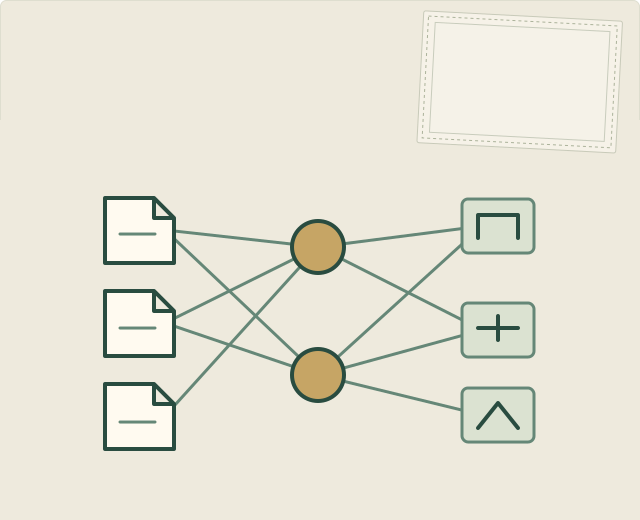
A curated shelf holds papers in collections, while project enquiries draw on them in different ways. This map keeps the sources, observed filing relationships and explicit editorial uses distinguishable.
Purpose
Portfolio Wave · Reading map
Follow an idea into an enquiry.
A useful paper may help several experiments in different ways. Begin with a question, inspect its sources, and see what each reading contributes—and where its promise ends.
Loading the dated public selection…
1. Reading routes
Choose a route
Every source has the same size. A frequently filed or tagged source gains no importance bonus. Use the source list below with a keyboard or on a small screen.
What does this connection mean?
Select a source, collection or foray. Source uses state an interpretation and a boundary. Collection membership and tags record how material was filed; they do not demonstrate a theory or prove that two ideas are equivalent.
Sources on this route
Reading relationships and provenance
This snapshot follows the 15 current best collections in Portfolio Wave. Canon, second-tier reading and the Powell chapters are collections, not invented forays. A collection may lead to several enquiries; a source may do different work in each.
Solid green source-use edges are editorial interpretations grounded in named source passages and the receiving question. They are separate from grey collection membership and dotted subject-tag edges. Tags describe overlap, not citations, conceptual equivalence, importance or scientific validity. New epistemic-planning papers have few subject tags: that is a metadata gap, not evidence of weak relevance.
Maitria’s book, website and toolkit are filed across ten collections. Their three source records remain visible, with equal sizes and no degree-based ordering. The explicit use here is to orient the separate Maitria enquiry; cross-filing does not make the programme a master theory of the other forays.
Only selected public bibliographic metadata and editorial relationships are published. Private notes, annotations, internal identifiers and local database links are excluded. Retained older bibliography is labelled separately from freshly inspected passages; a public link is not a claim of reproduction or a complete paper review.
Source-use review triggers and stable foray identifiers remain in the downloadable snapshot. They support maintenance; they are not instructions for the next enquiry.
Download the curated snapshot · Provenance and refresh method